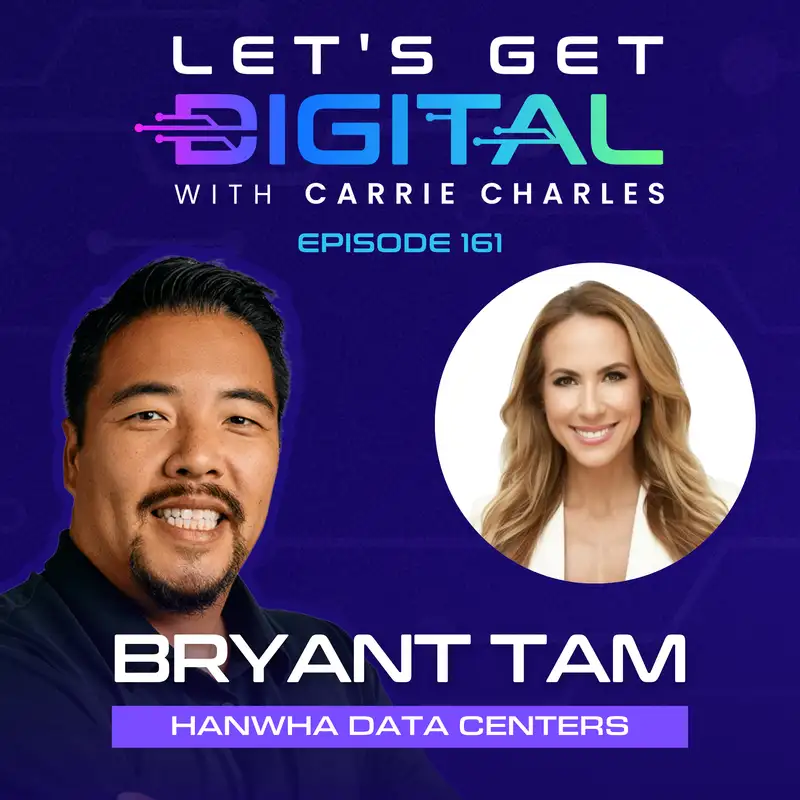
Carrie Charles (00:00.991)
Welcome to Let's Get Digital. I'm Keri Charles, your host. And I have with me today a gentleman that I met at, I believe it was Data Cloud, the event a few weeks ago, and just super impressed with him, his company. Also, he's an ex-Googler, which we'll hear about that and what that means, but today with me is Bryant Tam. He is the Vice President of Hanwha.
data centers. Bryant, thank you. Thank you for coming on the show so soon.
Bryant Tam (00:33.634)
Yes, absolutely. Thanks so much, Kerry, for having me. I'm super excited. Loved your energy at the show, and I know we're running around a mile a minute, but happy to be here and happy to spend some time with you.
Carrie Charles (00:44.819)
So are you called an ex-Googler or a, what are you called when you leave Google?
Bryant Tam (00:51.144)
Yeah, so as you know, us Google employees are called Googlers. And then once we leave the company, we are given an endearing name called Zooglers. So it's like an X instead of the G. So really strong community, actually, of Zooglers out there. so yeah, so technically and formally, I'm a Zoogler.
Carrie Charles (01:16.533)
It's kind of like once a Marine, always a Marine. I was in the Marine Corps. So it's like you just transfer to another name. That is awesome. Bryant, let's talk about where you came from. And you've had a very interesting journey to get to where you are today to this seat. So let's go. I'm excited.
Bryant Tam (01:23.502)
That's right.
Bryant Tam (01:37.848)
Yeah, absolutely. you know, I always kind of mock.
on LinkedIn, know, there's a lot of folks that put like X Google. I do it too. X Google, X this, X that. So I have on my headline, I'm an ex Jamba juicer. And so my first job in high school was actually Jamba juice. And I would make smoothies for everybody. And it's really where I learned customer service, right? And I think every kid, every person should do something in retail or restaurant.
job business. think you learn so much from that kind of a job. But after college, I thought I wanted to be a management consultant. I wanted to travel the world and all that. That didn't really pan out the way I thought it was going to be. It was a lot of boring travel to very boring places. And yeah, it just wasn't a fit, you know, but you don't know until you really get into it. And so I jumped over to SoCal Edison, right? And that's kind of my first foray into
Energy working at the utility. I spent six seven years there had some of the most epic jobs there My favorite one, you know aside from building substations and power lines was I was a operation supervisor for one of the districts and so those are literally the Crews that go out and climb the wood poles or score power in an outage and so I was overseeing the woodier district and and it was six major LA
and you'd get calls in the middle of the night and it was so rewarding to be able to turn the power back on, right? Air conditioning and often sometimes medical systems for people that need and just, it was a great job. It was my first time managing union employees. So that's probably a whole separate topic on its own, but I got a lot of great experience there. I met a lot of great people, but ultimately, I wanted to do more, I wanted to do something a little more fast.
Bryant Tam (03:41.6)
I went to a startup
worked a year there and it felt like 10 because it's a startup and you were doing everything right so I was ordering snacks for my warehouse workers to you know figure out the strategy for you know the next two to three years and so it was so much fun but ultimately it was also you know 80 90 hour weeks seven days a week so probably not really conducive to starting a family so I ended up you know finding my way to Google Google called me and they said hey would you would you
want to come up to Mountain View and do this job. And actually it wasn't in data centers. It was customer operations. And what they were doing was, I call it, it was called Google Express. It was a new product idea they had. And to put it in the best way, it was Instacart before Instacart. So they would actually have people go shop for you and then send it. But it wasn't really scalable and Google didn't really quite execute that idea perfectly.
Instacart clearly did. And so I tried it because I was like, look, it's Google. I'll do whatever you want. can, you know, I'll wipe the tables. I'll pick out the trash. Like as long as I can be at Google, that'd be awesome. So I spent about, you know, about a year in that role. And then, you know, when I knew that that product wasn't really going to make it, I was like, well, before I leave Google, let's figure out like, what did I really have a passion about again? And it was construction. It was being out in the field and building.
stuff. And so I remember one night on my sofa and I was on our internal job board and I typed in construction, just the word contract, just to see what did Google do in construction. And all these data center roles started popping up. I was like, data centers, like Google builds their own data centers, like they're a tech company. Why would they build their own data center? They just pay someone to do it for them. And one thing led to another. And then I spent seven years in that organization.
Bryant Tam (05:44.564)
doing site acquisition, site development, power supply. We were rezoning properties. I was getting to fly all across the country. And I just fell in love with all of it, right? The role, which is I think is an appropriately titled role, was a strategic negotiator at Google. wasn't like, yeah, it is. And people thought like, what are you like some FBI negotiator for Google? I'm like, no, like everything that we do in the data center industry is all a negotiation.
Carrie Charles (06:03.721)
I like that title.
Bryant Tam (06:14.56)
I'm negotiating for land. I'm negotiating for power. I'm negotiating for water. So I felt like it was appropriate and I love negotiating, right? Like I love when my friends want to go buy a car. They hate it. They hate going in the car and this. I'm like, please bring me. I will, I will negotiate them and I will them down to the last dollar. I'll get you the floor mats on the air freshener. So I honestly love it. And so I spent seven years there, loved it. And ultimately it was like, let's, let's see.
what else is out there, right? I enjoyed my time there, but I felt like there was something else going. The industry was growing so much. I've had a lot of opportunities to take different ones along the way, but I love the people I work with at Google, love my manager, and it made it such a fun place to work. when Hanwa reached out, they said, hey, we have this idea. We want to use the Hanwa brand and start building data centers, energy campuses across the country. Will you help us lead it?
And I've had opportunities like this before and I said, what makes you different? Like there's a ton of folks out there that are trying to do the same thing.
And so I know we'll dive into it, but Hanwha with the backing of the company, the international presence, I felt like was the way to make the jump. And so I've been here for about a year. have a full blown team here and we're doing some amazing things and I'm super excited and no regrets. I absolutely miss all of my old colleagues at Google, but this has been such an amazing journey so far.
Carrie Charles (07:50.006)
So let's talk about Hanwha data centers now. You definitely made a splash at Data Cloud and thank you for the coffee by the way. Thank you for all the coffee and the green tea and the matcha and I think I went over my budget. But tell us about Hanwha.
Bryant Tam (07:57.87)
You
Bryant Tam (08:08.022)
Yeah, so Hanwha is a company founded in 1952. interesting fact, it was actually in fireworks and explosives. And so over the years, over the past 70 years, they've gone into energy, aerospace, finance, advanced materials. They have over at least 50 to 75 different affiliate companies. Some are much more well known than others, for example, Qcells. So Hanwha
owns Q-cells, which is the largest manufacturer of solar panels and modules. We have multiple factories in the state of Georgia producing those domestically here in the U.S. Very proud of that and proved to be very strategic when the tariffs rolled out. And other areas that we're in, Hanwha Energy, which Hanwha data center sits under, we do things like LNG, obviously solar, hydrogen,
battery storage. so Hanwha data center sits under Hanwha Energy and is out there acquiring land and developing it. Other interesting companies that I'm learning about is like PSM. PSM is a company that we own that actually retrofits and refurbishes natural gas turbines, which in this day and age now in the data center, natural gas turbines are tough to come by. And so we have a lot of
that expertise in-house, we'll talk about, but it's definitely an advantage for us, why I feel so proud to work for Hanwha. And yeah.
Carrie Charles (09:48.47)
Okay, so let's talk about what makes you different. A lot of companies say we're different. always ask guests on the show what makes you different, but really tell me what does Hanwha do differently that changes the game?
Bryant Tam (10:02.915)
Yeah.
Absolutely. So to your point, I have an anecdote, right? It's so easy to get in this data center world, right? As a data center developer, right? I think it costs maybe in the state of California, $800 to create an LLC, and then you just rent a WeWork, and you essentially have a data center company, right? then, so the barrier to entry is very low, and so it's very hard to differentiate yourself from the mom and pop developers.
versus an actual data center developer. A lot of companies have money. Some, and a lot of people have huge teams. They tout hundreds of thousands of folks across the country and we're a huge data center developer. But honestly, I feel like that's part of our advantage. So yes, Hanwha has money, right? And we actually don't, our data center team, proud to say we're 10 strong, right? And I don't want hundreds of people, at least not today and not probably in the near term.
What advantage we have is that we can make decisions super quick. I've been in the belly of the beast of these massive companies, hyperscalers and I...
friends and data center development shops. It's analysis paralysis. There's so many layers to go through and you can't make a decision quick enough. And this industry favors speed, right? Everyone's telling you, how can I get more power? How can I get my power standard? Can I get it tomorrow? Can I get it next week? So that is a huge advantage for us. The other advantage that really changes the game is that Hanwha is an energy first company, right? And that's the motto, right? Land is so easy to find nowadays.
Bryant Tam (11:42.48)
right? It's land, it's cheap, it's plentiful, it's power, right? If there's power, that's what makes the land valuable. knowing that most hyperscalers are thinking of power first, we are also in that same kind of mantra. And because Hanwha Energy has all those companies that I mentioned earlier at our fingertips, while our team is 10, the backing that I have at my fingertips is hundreds if not thousands and hundreds of years of experience.
natural gas plants, building solar fields with BESS, doing hydrogen. We have owned one of the biggest fuel cell deployments, which is still being tested here in the States. We own and operate one of the biggest ones in Seoul. So the innovation is there, the engineering, the technical expertise is all there in that backing. And so what we do is we genuinely provide the best complement mix of energy solutions, not only for the customer, but also for where we are.
in the country, right? It doesn't make sense to go to California and try to do a natural gas plant. But in Texas, yeah, it does, right? Because gas is cheap there, right? And the land is relatively cheap and the regulatory environment favors that. we put that kind of strategic thought in that knowing what our hyperscalers want. We all, my team is full of ex hyperscalers. So we know exactly we've been in the, you know, in all these companies that we're talking to. So we go, yeah, we know that you, you know, you do things this way and not that way. So
So that's why this site we feel is a great fit for your company.
Carrie Charles (13:15.445)
Okay, you win, you are different. I get it. First of all, let me say I wish I had a dollar for every time I heard the word hyperscaler. And there's so much hype filling our industry now in the data center world. And you've been on both sides of the table, right? So you've been on the hyperscaler side, now you're on the data center side here. And...
Bryant Tam (13:17.518)
you
Bryant Tam (13:25.336)
Mm-hmm.
Carrie Charles (13:42.995)
What do we, what's real, what's noise? You know, let's dissect it.
Bryant Tam (13:51.042)
Yeah, so one thing I always say is if you're in the data center industry and you follow enough folks, you scroll through your LinkedIn feed, there's a ton of announcements.
Blah, blah, blah. I almost have a formula for it. Blank announces a blank gigawatt site in blank state, estimated spend blank billions of dollars. And then there's an AI photo of a data center campus. Very clearly AI photo of a data center spanning thousands of acres. And always tell people that cost zero dollars to make.
and five minutes to create and post. And so you have to sift through that noise. Some is real, right? Like Oracle spending real money, the hyperscalers spending real money, but even then they're allocating money, right? They haven't actually spent it. The money has not gone out the bank. So you have to be able to filter through that. I think there's a lot of noise there, a lot. There's a lot of deals being made for sure, but if you just skim through that, you're just like, wow, hyperscalers are buying everything. And these developers are snatching like 10,
15 deals and making billions and billions of dollars. So people think that they there's so much money in this to be made that if I have a plot of land and I have a power line running over it or across it, I can make millions of dollars too. And so I think that's a noise. I think that's a misconception. There's obviously so much more that goes into that. Right. And so one thing that I think folks have to understand is that these hyperscalers developers, yes, of course, they have tons of money and they have hundreds, not thousands of options. I remember being
there and I would get texts I don't know how they would get my personal phone number my cell phone number because I used Google I had a work one and I had a cell phone number a personal one they would text me on that they would hammer my LinkedIn they'd follow me literally to conference bathrooms to pitch me like
Carrie Charles (15:43.997)
It wasn't me, I promise, it wasn't me.
Bryant Tam (15:47.286)
He was very polite and professional. But I've had that. I've had somebody like they saw me. I saw them and I was like, I don't know this person went to the bathroom and they saw the Google badge and I came out and they like, you know, it like, Hey, you know, how do you like your cable service? You know, like it was like, it was really like in your face and I can appreciate the hustle for sure. But that's I'm just selling that story because it's like hyperscalers have
no shortage of choices of land and power options. So as someone on been on the other side, how do I sift through that noise? Right? Because I can't follow up on every single phone call, every single lead and give everybody my time to look at their sites. Some may be great, some are not, are definitely not great. And so people have to understand that your relationships and your reputation matters and the rest of it is really a lot of noise. Right? And so I think that's some things that I would love to clear up on this forum.
Carrie Charles (16:42.197)
So one thing that I really enjoyed talking to you about was culture and hiring and people. And I want to go there a little bit because I really love your ideas. you know culture is this buzzword, we hear about it all the time, I mean just, you know, it's everywhere, right? And it has been for our whole lives. But how do you actually, and again I want to get real here, how do you actually build teams that perform and stay?
Bryant Tam (17:11.406)
Yeah.
I always look at it this way. I can give you some real examples of how I thought through this and how I actually executed this. I think it was me and another one of my team as the only two for this data center team. And we talked about it I said, what kind of culture do we want here? We want entrepreneurial culture. We don't want somebody that's going to be reactive. We want proactiveness. We want somebody that obviously has some hyperscale data center experience, but that aside,
kind of attitude do we want? What kind of personality do we want? And that was really important. We wanted transparency. We have to have fun. That is a huge thing. My whole team chat is all GIFs, memes, and emojis half the time. But I think that's important. And I wanted to make sure that everyone had a sense of empathy. That's really important for me. And so when I'm thinking about these cultural aspects,
that I wanted for my team, then I go and I do my hiring and I do and obviously they've got to meet all the technical job requirements but beyond that it's getting a feel for how do they, how do you react? What is a small talk like? Right? And that matters, right? We've been well trained at Google, unconscious bias and so we keep that at the door but you know it's how do they interact because I'm gonna need this person to interact with the vendor, I'm gonna need this person to talk with the hyperscaler so communication skills are really important.
Right. And so when we think about culture and how I set the example, right, as I do what I say I'm going to do and I really try to make sure that I let people know that I'm not afraid to start a spreadsheet and work through it. I'm not afraid to do the admin work. I've I figured out, you know, with my team for the data data cloud conference, you know, figure out the marketing of it. Like, do we have napkins for the coffee cart? Right. Do we have what about pens and do we have the logo to
Bryant Tam (19:12.016)
and I'm ready, we gotta shift that off. I'll get the tablecloth. So there was all of this, I do the admin work with the hiring and the strategy work. Nothing is beneath me and I expect the same with my team, no matter where you are in the organization. You help where you need to help, lend a hand. If you've got a little bandwidth and you see a teammate drowning, help them. But at the same time, I set very clear expectations. I manage to them and I will fight and I will defend my team almost to a fault.
And I'm proud to have that brand from Google. A lot of endearing comments when I left that it's just not the same. You did something different over there. And so when I heard that, was like, that's what I'm bringing to Hanwha. And I hope my team today would say similar things about that too. But I really do care about everybody on my team. We have to get the work done. But aside from that, things I do is we are a decentralized team. So we're all across the country.
I force, know, force but highly encourage quarterly like off sites. We'll get together somewhere and we just work together, right? Sometimes there's a strict agenda. Other times it's just working together. We'll go do something fun together. We'll go, you know, have team dinner together and we learn about each other's lives, you know. One of my teammates announced that they're expecting and so, you know, we love that. We embraced it. I went and go bought cupcakes and cookies and we celebrated a team dinner and we're so excited for
for this person and we're there to support them. like whatever time you need, the other nine of us will step up and cover for you so you can enjoy time with your newborn, right? And that's important. That's what keeps people.
Carrie Charles (20:54.655)
So, Brian, and I, my gosh, I love this. How do you do this at scale? So again, I'm looking at a, let's say someone who's listening from a much larger company. What are some ideas and thoughts you could give to them?
Bryant Tam (21:10.574)
So I think it's really important when you're thinking about like, if you have a large organization, you have a kind of a management team that has their own team, right? And so it's for me, it would be, set the tone at the top. so sometimes that's hard to do if you're middle management and your leadership doesn't really support all of that. They may not just because of the company culture or their own personal desires. so oftentimes you have to be creative. There's a thousand reasons why you can't do it. And I've been in that role, right?
And so at Google, yes, maybe there, but even at Edison, where it's a little more conservative, right? You have to work within your confines and be creative just because you can't have quarterly off sites and go do these amazing, crazy things. Can you figure out a time where you're all together in a room and do something fun, right? It doesn't have to be expensive. It doesn't have to be super fancy, but I think it's those little things, right? So we would do, one of my colleagues came up with a great idea.
every Monday there's a Monday morning question and he just poses it out to the team and we learn something about each other. Like one was what's your favorite fall thing that you look for now that we're in fall? People are like, sweater weather, know, pumpkin spice lattes and others are like, I'm excited for this new show that comes on and then we go to Bunny Trail and learn about what this person likes about shows and so that costs nothing, right? And so that's how I'd say if you
have a full like upper executive that supports those kind of things that I mentioned. But that's why also I love this opportunity with Hanwha was like hey I get to kind of be at the top so I can set that tone and the way I plan on scaling is my management team firmly knows what I believe in and I support so when we start building out bigger teams that I expect them to build that same culture because that's the tone I set at the top.
Carrie Charles (23:06.781)
So hiring is, it's difficult right now in the data center world, in the fiber world, digital infrastructure world. so what are some specific strategies that you use to find qualified candidates and top talent?
Bryant Tam (23:24.578)
So that's interesting, right? So the data center industry right now is so competitive, not only on total compensation, but the other things. I have a couple of anecdotes, right? It's not always, I can tell you, it's definitely not always about who pays the most, right? It is very much, people are very keen on culture.
Some things that I do to set ourselves apart is because our company allows for this on our team remote.
Right? Allowing for remote or even hybrid has allowed me to pull very talented people away from bigger companies that have a much more strict in-office requirement. Right? I go back to, I set clear expectations and I manage to them. These are all adults. We're all adults. I don't care if you have to go to Whole Foods to go get milk and eggs at 10 o'clock. I just expect that the things that you need to get done are going to be done.
Right. So I'm like, I think that's like, these are small things that you can do. Hopefully your company supports them, but things that you can do to set yourself apart because it's hard. can't, how do I compete with hiring a Google? Right. Google's looking for a data center person. I'm looking for them too. How can I differentiate myself so that we are, we are a, a top consideration for them. Right. So it's, it's culture. People will ask people at the company, Hey, I'm thinking about applying for Hanwa's data centers role. That's open.
What do you think about it? Like how what's the culture like what's what's working for Bryant like and hopefully it speaks for themselves and that they're honest and brutally honest and that sometimes helps other things that I do to try to secure this town is obviously network network is really huge and referrals so I Have normal people that I go to and say hey, I'm looking for an XYZ position fully remote Who do you know that's that's maybe looking for some opportunities, right? And so obviously
Bryant Tam (25:23.763)
confidentiality and all that is really important in this industry, but you just kind of never know and sometimes People aren't ready to move at that time. And so that's what happened six months ago. I trying to bring someone on I'm really happy here. I'm like cool. Well, I will keep checking in right and so it's kind of part of that whole like yeah I'm the VP and but I'll do pen designs for a conference, but I'll also start doing recruiting for some of my key critical roles I'm I care that much about my culture
that I kind of get maybe to my HR team's demise. I get very involved when I'm hiring talent for my team. I want to make sure that they're the best fit for our team.
Carrie Charles (26:06.141)
So bringing young people into our industry is critical, right? And so many people talk about it. Not a lot of people do it well. I think we're really just trying to figure it out. What would you say is the playbook for mentoring and sponsoring young people so they get into our industry and they stay?
Bryant Tam (26:30.348)
Yeah, so I think a lot of companies do this really well. We actually have done it a couple of years in a row now is college interns, right? That's kind of low hanging fruit. I think a lot of people don't know about data centers. And so I try to find avenues and try to really poach or at least talk to certain interns. So like I'll go to colleges and I'll talk to their energy club, right? Or lot of places have a real estate club.
Shameless plug Keenan Flagler Business School. They have a great real estate club They have a great energy club and I'm often in contact with them too If there's any opportunities for me to go speak be a guest speaker share more about the industry You know, they a lot of them don't know about it or they don't know what's behind it, right? And so My my undergraduate alma mater UC Irvine. I've done a lot of like undergraduate business Association or something they'll ask, know, hey, do you want to do like a panel? So yes, it requires
as a lot of little bit more effort but getting getting the data center name and the roles out there people don't know what it is they're thinking data centers like does that mean like wiring up racks inside of a you know
Building like no there's like you can get into real estate. There's economic development. There's regulatory for community engagement So many different things that you can do here You're an engineer. Yeah civil mechanical electrical great if you want if you like real estate, right? There's you know, you this is a huge real estate area if you're into energy energy supply So I think that's one one way you can do it. Others are a mentorship programs, right? So I'm an executive mentor for Asian American
Association, AAPA, it's a local smaller mentoring group here that I take on two or three mentors throughout the mentees throughout the year, help them with their own career right and a lot of them ask what is data centers and how do you get involved and so trying to get that word out to the younger generation is an effort but I think it's kind of one of those things where I feel like I'm doing a part of it and if everyone did that little piece and tried to mentor and try to do one speaking engagement at your alma mater
Bryant Tam (28:42.32)
data centers, the work would spread pretty quickly. And from what I experienced from our interns, the ones that have done and worked in, exposure to data centers, they're like, wow, I didn't know this even existed. This is actually pretty cool, right? And so that's, for a college kid, that's a pretty good, I would say glowing review, right? And you're probably not gonna get much more than that from an 18, 19 year old.
Carrie Charles (29:08.009)
Hold on one second. I think, so let's cut here. Did you hear the sound go out for a second or was that just me?
Bryant Tam (29:14.844)
No, I didn't hear it.
Carrie Charles (29:16.817)
Okay, very good. So what we'll do is we'll pick back up now, but just in case the sound went out, I want you to, because it was just out for just the very last sentence that you said, she's probably just gonna cut part of that, but just say something about like the last point. Let's just pick up there and just start talking about it, okay?
Bryant Tam (29:39.822)
I I can pick up. Yeah.
Carrie Charles (29:46.418)
So three, two, one.
Bryant Tam (29:48.93)
Yeah, and so I think the biggest thing that we can do is everyone does a little bit, right? So I feel like I'm doing a small part in attending panels, going to colleges, career fairs, things like that, mentoring. I think if everyone kind of picked up one or two things locally, you know, don't have to travel the world, locally get involved with your hiring efforts. I think all of that, we can make a really big impact and get more younger students and younger professionals into the industry.
Carrie Charles (30:17.577)
Love it. What is your bold vision for Hanwha?
Bryant Tam (30:25.374)
This is a good one. And I have a lot of hopes and dreams, right? And that's what kind of, I love being an entrepreneur and, you know, and this also afforded me that opportunity, right? To be an entrepreneur and grow something from scratch in the kind of the safety of a much larger company. And so my vision for Hanwha data centers is that, you know, we fully branch out and become a full blown affiliate of Hanwha and that I can grow.
a team that replicates our model that we're doing on, you know, we have a handful of very advanced sites that we're working on and I'm hoping that we can scale it. And I want to do it in a methodical way. Very much the the tours in the hair. I'm doing slow and steady. There is no rush here. I don't get back to the hype. We don't we don't kind of get blogged in all the announcements and things like that. Stay focused on our mission and our vision and start building from there.
and build our reputation and credibility in the industry. One fun anecdote that I'll credit my dad, he gave me, is like, when you get into corporate America, you know, think about it as a life of collecting poker chips. And I said, what do you mean by that? Like, I gambling? And they're like, no, no, no, no, no.
Like when you're young in your career and you're starting out, right? Your job is to collect as many poker chips as you can. so how do you, dad, how do I collect these poker chips? And he goes, when someone, anyone, whether it's a peer, whether it's a manager, certainly an executive, asks you to do anything, you raise your hand first. You raise your hand first and yes, you do it. And you do it really well, right? Cause you don't also want to do a crappy job. You want to do a good job. You get one poker chip, okay? And you do that and you collect as many poker chips, help a colleague out. You get a poker-
chip because you want they remember they had to give you a poker chip they gave you a poker chip from up left right and around so now when you build your career you have a pot of poker chips now when you ask for a favor you have poker chips assigned so you can go back to that executive but guess what when you when you need a favor from that executive for and you have to cash in your poker chips it's five poker chips so you work really hard to get that credibility and that trust and so you can cash it in but it costs
Bryant Tam (32:43.664)
a lot and so you know that was an analogy that always stuck with me I tell all my young mentees to get have that right mentality when you come and don't come in entitled don't expect you're be promoted to VP tomorrow collect your poker chips that brand will carry you far in your career
Carrie Charles (32:59.061)
Brilliant advice. Every single person who's listening to this show right now, please share that with your kids, with your kids' friends, with young people in the industry. Perfect. So how will the industry look different? The data center industry look different in five years.
Bryant Tam (33:17.876)
I think this is going to be an upward trajectory. So I only think that it's going to, the demand for power is going to increase. And while I don't think the slope of that line will be quite as steep as maybe people think that it is, I still think it's going to be up into the right. And so that's where I tell our team is like, we're not going to start doing some crazy things to kind of address the peak or what we think may be the peak. Part of that reason is a lot of the hyperscalers, everybody,
They're we're all guesstimating. They have very smart people doing it. I'll give them that but they're all guesstimating at how high this peak is going to be but nobody knows because nobody knows how far AI is going to go. But I do know we're in the very early stages of it. So I do foresee the industry continuing to grow up into the right. I think Han was positioned extremely well to be you know at the forefront of that growth. I also think that unfortunately we're probably going to see a lot of the speculators fall out right.
And and what I mean by that is the three people in a wee work, those will probably go away. The ones that say, hey, I do commercial real estate and I have a few warehouses I want to get into data centers. I think those will go away. I think the folks that were trying to play off the natural gas and say, I've got 500 acres and I can build you a Nat gas plant. I think those will go away as well. Probably a hot take from that standpoint, but I do think that some of that industry will thin out, which I think will be good.
utility queues, it'll kind of separate the real developers from those that are just trying to make a quick buck. So I think it's a good thing for the industry that that happens.
Carrie Charles (34:57.941)
Brian, how can we learn more about Hanwha data centers and also your careers page? Because after listening to this and your team and your leadership style, and I want to come work for you.
Bryant Tam (35:09.912)
certainly can't afford you, Kerry, that's for sure. And we need you out there. We need you out there bringing us amazing talent, running this amazing podcast. But jokes aside.
Carrie Charles (35:19.733)
Thank you.
Bryant Tam (35:21.262)
HanwaDataCenters.com and you can get a link to our careers page. We actually do have several roles that are going to be coming up here over the next two quarters. And then also we're obviously on LinkedIn. I'm on LinkedIn. I've kind of infamously been known for my weekly highs and lows summary. So, you know, definitely connect, follow along and, and, you know, I'm brutally honest on those and, and let's see where this industry can go.
Carrie Charles (35:50.901)
Brian, this has been a blast. Thank you so much. I am really excited we connected and we are gonna be great friends forever.
Bryant Tam (35:58.73)
Absolutely. Thanks for the opportunity.
Carrie Charles (36:00.831)
Take care.
All right, stop.