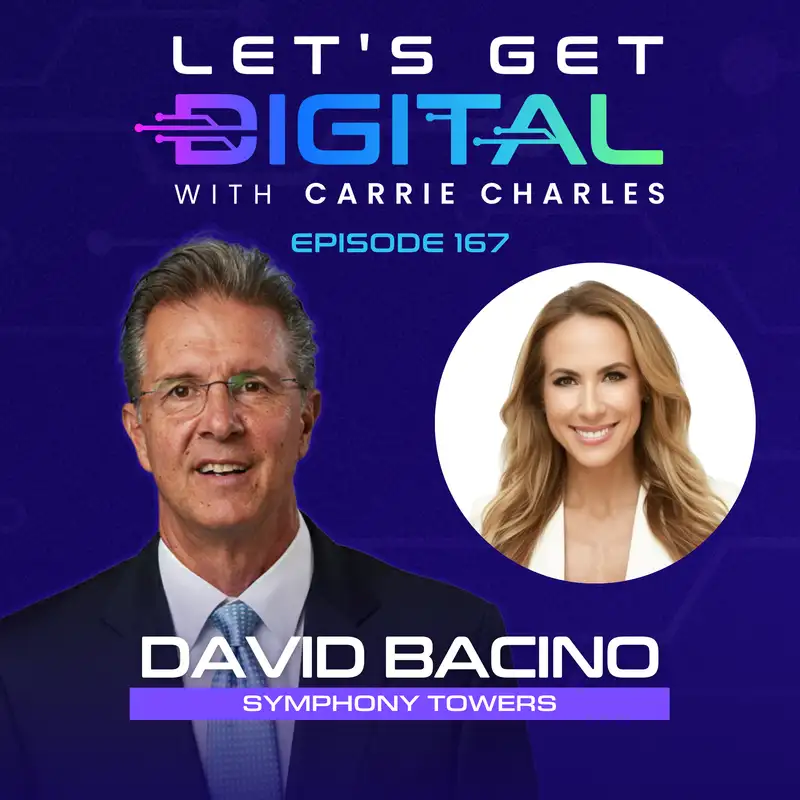
Thanks for joining me today on Let's Get Digital.
I'm Keri Charles, your host, and I have the pleasure today of having with me virtually
David Bacino.
He is the Towers operating partner for Palistar Capital and also now serving as the CEO of
Symphony Towers.
Dave, thanks for joining me.
I'm excited you're here.
Yeah, Kerry, thanks for inviting me.
Great topic and I appreciate your time.
Yes, I've been, gosh, I've been doing so many shows on data centers and energy for data
centers lately, so this is exciting.
We get to talk about Towers, the backbone of connectivity.
So first and foremost, I wanna know about you.
So tell me a little bit about just your background, your experience, and how you got here
today to the CEO seat of Symphony Towers.
Well, you know, I've been in this ecosystem, gosh, 40 years now, believe it or not.
So um I've been with uh Carrier, I've been with Infrastructure Manufacturers, I've been
with Infrastructure Ownership, and now I've gotten to be with the investor that owns and
holds these, and now we're operating at Symphony Tower.
in a quick snapshot, I spent uh early years with Nextel Communications, so I got to see
the...
the carrier side of the world.
I then got to spend some time with a satellite provider called TerraStar Networks.
So I got to see competitive infrastructure.
Then I went to a company called PowerWave Technologies and we built uh splitters,
diplexers, antennas, uh part of the core infrastructure that went into the networks.
I spent some time at American Tower and then I was able to join Palastar and we invest in
digital infrastructure.
And as you can see, we've assembled over 3,000 assets in Symphony, and I'm running
Symphony Towers for them today.
What do you love about the industry, Dave?
What just keeps you in it?
Well, you didn't put that down as one of my questions, Kerry, okay?
But no, you are, that's fine.
uh You know, I love that uh it's a product that's being used by everyone and it's a
commonplace uh offering that no matter who you're talking to, they have an opinion on it.
So that I like, because I'm connected to everyone in what we're doing.
I also like...
being on the infrastructure side, that you're really on the fulfillment end of, it a uh
proposition.
The needs generation is done by people that use these wireless products.
The fulfillment is the infrastructure in place to deploy the connectivity, which is the
wireless network that allows that device to function the way it does.
So.
It's been a great industry.
I actually have a paperweight on my desk right here and it says right place, right time.
And I didn't coordinate that.
It's just what happened.
And so I've been very excited to spend 40 years doing this.
I love it, I love it.
Well let's talk about Symphony Towers.
Tell me all about it, all about the company and also about what makes you different.
Well, Symphony Towers is owned by Palistar Capital.
we have a strong financial backer and we're 3,000 assets that are rooftops and towers.
When I say we're supported by a financial backer at Palistar, gives us the capital to
acquire new rooftops and acquire new towers and then to offer those to the carriers as
they deploy their networks.
And you their networks have either challenges from a capacity standpoint or a coverage
standpoint.
And so we try to align with their needs and either buy more towers or buy more rooftops,
which brings value to the carrier community as well as helps us be a common interface with
those infrastructure owners.
So you're sitting at the crossroads of real estate and telecom.
What are or why are towers such an exciting opportunity for property owners right now?
Well, I would say that the property owner, well, on land, there's two ways to really look
at it.
A property owner can be a building owner and his rooftop is available, his or her rooftop
is available for co-locations of the wireless carriers.
So it's really a tower that the carrier doesn't have to build.
They just use the rooftop location.
So that's of great value to them.
And that is a crossroads of real estate.
The other is if you're uh a land owner and you work, uh
partnership or relationship with a tower company and you lease or sell the land so the
tower can be built there.
So both of those are financial transactions that would make a property owner or a building
owner, I was delineating between land or structure, that more valuable than they presently
see it.
So break down the revenue side for us.
How can rooftops become income generating assets for, like you said, apartments, hotels,
offices, all other properties?
Well, I won't go into the exact math that goes behind it, but what happens is if you own a
building or an apartment and you have your tenants inside of those buildings, well, the
rooftop is worth uh value as well.
And normally it's a revenue stream or a lease that the carrier will transact with that
building owner and uh get long-term revenue stream that gets associated with that.
Now at Symphony, one of the things we do is we go to that building owner and say,
why don't we buy the economic rights through an easement for that rooftop?
And then we can continually market that and make it an available site to carriers as they
deploy their networks for either capacity or coverage requirements.
So what does the future look like for rooftop deployments and where's the biggest
opportunity right now that you see?
two questions in one, but I would say uh the future looks bright.
I mean, as long as people continue to use their wireless products, that's the front end
demand driver, there's gonna be a requirement for more infrastructure.
uh The only way you can fill more demand of a wireless product is by more spectrum or by
uh greater utilization of that spectrum, which is by putting uh more infrastructure points
of presence for the
the deployment of radio frequencies into place.
So it's extremely strong because I mean, I have three children that use their phones
continually.
There's new apps on it every single day.
So I think the requirement for capacity and demand is only growing.
So I think building and rooftop owners uh will continue to see more and more value because
people need more and more locations to deploy their radio frequency as a carrier.
And the opportunities are practically endless because there's new buildings being built
all the time, right?
New developments being built.
So those are opportunities for you to go there and provide rooftop, right?
Rooftop coverage.
They are, you know, once a town or an ordinance provides zoning to one rooftop, they're
normally not gonna provide it to, you know, five buildings in one zip code.
They like to kind of keep the carriers installations at a common location, which is fine.
But um so I won't say unlimited.
I liked how you said that because the more demand, the more requirements that they'll need
from a location standpoint, but it does have some requirements around approvals.
and zoning commissions saying that that can be zoned a communication site.
Okay, let's talk about the tower industry today and the way that you see it.
There's been, gosh, there's just been a lot going on, a lot in the news and you know,
there's layoffs, there's things happening on the wireless side that, know, with Dish and
Hit This, there's just all kinds of, I guess, activity that we've noticed.
So what's happening right now and then where do you see the tower industry going?
let's say in the next five years.
I see it all positive, okay?
I see it's all by that demand creation, which is how much people use a wireless product
and what the applications for wireless products are.
um So today we think of it as voice, we think of it as data, we think of it as content
over wireless devices.
Now you have mobile cars, you have oh autonomous driving.
I think all that's growing, so I think...
from you called it the tower industry I'm gonna say the infrastructure industry which is a
building a tower or anything that's zoned for communication services which light poles are
even getting us today if you take a look at what's happening on the top of light poles so
I think there's just greater and greater demand because of the requirement of the user so
I think every single year we're going to see this industry grow I think we're going to see
the requirements of the industry grow
um And then I think when we understand what's happening between the next generational
shift of RF deployment, which is 5G to 6G, and I'm not an engineer to do the analysis for
you, but if the requirement is with less power, if you have less power, you actually need
more points of infrastructure.
So you're gonna have more requirements for towers, more requirements for rooftops to keep
the same network performance that the user's accustomed to.
So your question is,
What do I think's happened in the industry?
I think it continues to grow.
What do I think it's gonna be in five years?
I think it grows every year for the next five years.
I think that's actually 10, 15, and 20 years.
ah It's just wireless connectivity, I think, is not going away.
Well that's good news for job seekers, so love hearing it.
Beyond mobile, what new use cases are emerging for towers that people may not necessarily
be thinking about right now?
Well, I'm going to define mobile as the phone and handset that we all carry around today.
you know, public safety, first responders, um search and rescue, uh autonomous driving,
know, device tracking.
um There's a huge uh array of other wireless connected requirements that are happening out
there today.
So yeah, people normally think about our industry as the three big tenants, which would be
AT &T, Verizon, and T-Mobile.
But we talk to multiple other uh application providers that need connectivity, and they're
doing it wirelessly today.
Okay, I love hearing this.
It's all positive.
I'm getting inspired.
So I want to talk a little bit uh more about 6G.
What, I mean, just from your perspective, what's happening around 6G and also will it
reshape or change the tower world?
ah I haven't seen the specifications on 6G, so it's really hard to comment on that.
I think um it will enforce the needs and requirement for infrastructure.
And so I used the example earlier that if 6G is a uh lower power radio frequency
deployment, you're going to need more towers.
oh If it's higher powered, well, it's providing
faster services and benefits for the applications, which I think people just use them
more, which means people need more network, more connectivity, which means you need more
infrastructure.
uh once again, as you can see, I see it in a positive fashion.
I want to talk a bit about uh satellite systems, LEO, Starlink.
How do you see satellites impacting tower strategy?
Is it competition, compliment, something else?
What do you see in the future here?
I see it as a compliment.
um As you heard earlier, I actually spent a few years at a satellite provider, so I have a
feeling of how that actually works.
I think the macro networks that we see today, which is what delivers your connectivity
through radio frequency deployment, those aren't gonna change.
I think this is an overlay to provide fill-in.
I think there's some applications in remote rural areas.
You heard me earlier, you said what other applications use.
If you take like search and rescue, like, know, beyond land, people are not wanting to
build towers there as strongly now.
So I think satellite can fill some of those in.
I don't think it jeopardizes any of the networks that are in place today.
I don't think it jeopardizes any of the growth for the frequencies and spectrum that the
carriers own.
I think it's an add on uh adjunct, which is only complimentary.
Okay, that's good to know too.
We actually use Starlink.
I spend a lot of time in Puerto Rico.
uh just like you said, we don't really have many cell phone towers around us and not
really good Wi-Fi.
So Starlink works for us there.
Yeah, there's also a math equation that goes with that.
So, you know, if the population's there and you have the user demand, then a tower might
make sense.
But, you there's other elements that go into it, too.
You have power and backhaul that all needs to go to each tower.
And so if you don't have the ability to uh create a replacement of those costs, then
satellite might work.
But right now, your first question was, where do I see it?
I see it as a complementary service.
Okay, let's go back to Symphony Towers and talk about company culture.
And I know that, you know, that's something that's really important to you.
What is the culture of Symphony Towers and what makes it just a great place to work from
your perspective?
You know, it's interesting, Kerry, we talked about this earlier.
said, well, we maybe should start with this question versus end with this question.
Because to me, um that's what makes Symphony Towers so successful.
That's how the team bonds together.
That's how we drive towards common goals.
You know, this industry changes all the time.
You've asked me a bunch of things about, you know, what's happening with frequencies,
what's happening with, you know, different technology platforms, what's across the board
with applications.
So I want to create a culture where
One, we're all flexible.
We all put our arms around problem solving.
And we talk about taking the hill together at Symfony.
So it's not independent functional groups.
It's one business unit that says, here's what we're driving towards as a goal and a
strategy for the organization.
But we're a tight knit group.
We're small, but we're strong.
We're nimble.
I think we have a good ear and listen to the customer.
So, you know, very customer driven.
So I don't know how you put a single word on what that means in our culture, but um it's
strong in its energy.
People are happy to work there.
And uh we put a lot of focus on that, especially when we evaluate that on a quarterly and
semiannual basis.
What about leadership, Dave?
What are some principles that just really guide you when it comes to being a leader?
You know, I like this podcast because you gave me a list of five questions and you've now
asked me four that you didn't even put on there.
But, uh you know, I would say, no, I would say in leadership, and I'm not trying to say it
for me, but in general, I think that a leader needs to be clear with their uh message.
I think they need to be trusted.
I think they need to be visible.
And I think that they need to also give feedback.
So um I think that way that culture stays uh linked together and I think everyone is
commonly focused.
I also think that um leaders need to be decision makers.
I think they need to make a decision right, wrong or indifferent.
You can adjust, but you can't sit and evaluate forever.
So um I guess those are some attributes to leadership.
Maybe we can write a book on it.
uh
uh
But that's just a quick reaction to your question.
Yes, no, and thank you for answering a few questions that I didn't prepare you for.
I'm just in the moment with you, Dave, I'm in the moment.
uh The, you know, the vision, the long-term vision for Symphony Towers.
What do you see?
What are you creating?
Oh, I see a great partnership with the carrier community.
So there's two ways I can look at that, Kerry.
m One is, what are we creating for an infrastructure owner as we relate to wireless
carriers?
I see us creating an organization that um provides needed infrastructure, that's flexible,
that understands what the carriers need when you come to contracting.
That's the terms and conditions that they're executing to join our rooftop or our towers.
That's one thing we're creating.
I think when you look at it as an investor, because that's where Palistar comes into it,
we're creating um a vehicle of assets that have long-term stability to their revenue
streams that grow every year through escalators and additional use, because you asked if
people need the towers and rooftops more.
So I think both of those are being created as Symphony grows and uh
progresses on a yearly basis.
All right, I think we are done.
I'm finished with the questions unless you just want me to keep going.
m
listen, I appreciate the time.
I appreciate what you do for our industry, Kerry.
You're always bringing additional value to all of us with your insight, with your podcast,
as well as your company.
And I look forward to seeing you at many more of the industry events that are coming up in
2026.
Sounds good, Dave.
Thank you so much for coming on the show.
I really had fun.
Thank you.
You too.
Okay, don't move.
Don't move.