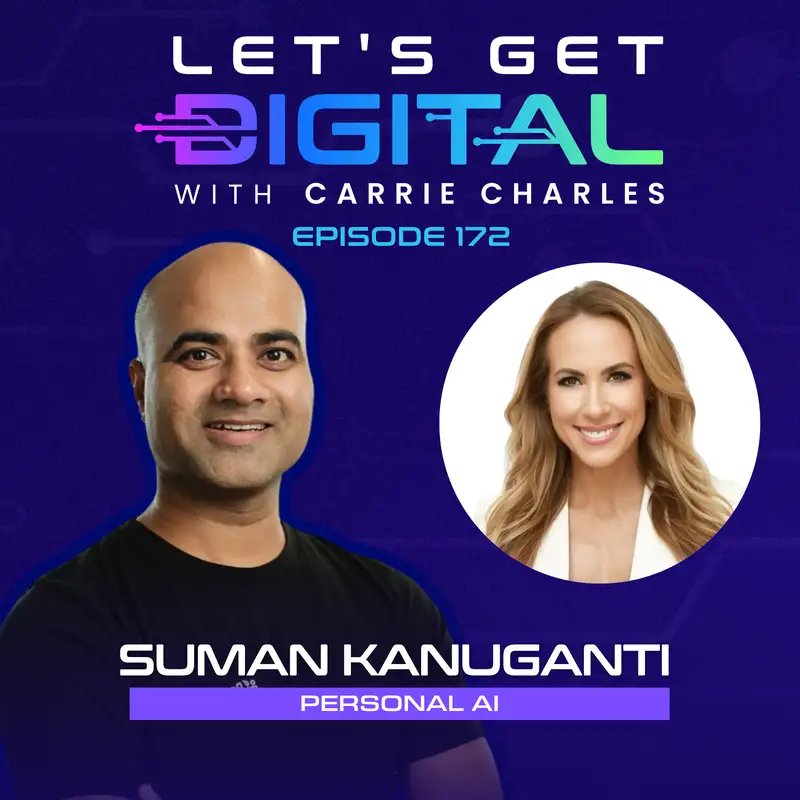
Carrie Charles (00:00.824)
Welcome back to Let's Get Digital. I'm Carrie Charles, your host. I'm thrilled that you're here. We have got a just a really amazing episode for you today on AI. So stay tuned, don't go anywhere. Go get a cup of coffee, cup of tea. You are gonna learn a lot because my guest today is Suman Kanuganti and he is the CEO of Personal AI. Suman, thanks for joining me today.
Suman Kanuganti (00:01.186)
Welcome back to Let's Get Digital. I'm Carrie Charles, your host. I'm thrilled that you're here. We have got a just a really amazing episode for you today on AI. So stay tuned, don't go anywhere. Go get a cup of coffee, cup of tea. You are gonna learn a lot because my guest today is Suman Kanduganti and he is the CEO of Personal AI. Suman, thanks for joining me today. Carrie, glad to be here.
Carrie Charles (00:30.402)
Yes, so let's first learn about you. Please tell me, how did you get started? How did you get into this world of AI?
Suman Kanuganti (00:30.783)
Yes, so let's first learn about you. Please tell me, how did you get started? How did you get into this world of AI? I'm an engineer. I grew up in India. Came to United States almost 20 years ago. I did my master's in robotics. And since I was a kid, pretty much as a person that grew up in the technology world, there was a point in my life, it's like, what do I want to create? What do I want to build?
During that time I at Intuit and I chose to kind of switch gears and get my MBA as well and then start jumping into the startup world and creating products and services. So I started my first company, which was called Aira. It's an AI company as well. This is for people who are blind and low vision. So that is now a default accessibility standard for a lot of blind people. And in 2020, I started Personal AI with this core problem of like how do we...
predict somebody's thoughts, right? Like what does it mean to be creating the intelligence based on a, you know, individual perspective, like what would Carrie do? What would someone do? So that started our journey in 2020. And naturally as a technologist, we landed on AI as a necessity to solve the problem. So AI was at the starting point as much as we had a clear problem of like memory, recall, intelligence, thoughts.
So yeah, know, fast forward five years later, here we are building a mainstream AI company, you know, in the small language model era from a technical standpoint. But at the core, we are so personal to individual people and everything that we do is centered around the, you know, knowledge and experiences and relationship as viewed by a specific person. And now it's expanding into
you know, things as well, such as a robot or a connected car, which we can talk more about, but I will pause there to your point in the background. No, so one reason why I really wanted to invite you on the show is that you work with telecommunications companies, major carriers. What are you seeing inside those networks that the rest of the, excuse me, the rest of the industry doesn't realize?
Carrie Charles (02:35.522)
No, so one reason why I really wanted to invite you on the show is that you work with telecommunications companies, major carriers. What are you seeing inside those networks that the rest of the industry doesn't realize yet?
Suman Kanuganti (02:56.008)
The internet definition is rapidly evolving, right? So the idea of being able to access the information we are used to over the past two to three decades using the internet. The most interesting and the fascinating things at the same time is with AI, not only how we do things on a productivity basis is changing, but how we communicate with computers.
and the digital world is changing, which is going back to the basics of voice, right? The idea of being able to talk to the computers to naturally do things for us and have a conversation naturally without having to use the keyboards and mouse is the new form of computing, if you will. So in the telco world, why would that be relevant? Well, if there are a billion Google searches a day today,
there are three billion phone calls, right, a day. So that means people do talk. And if you think about Google searches is one way, meaning people are consuming information. Where people talk, they create, right? When they create is where personal AI has the most benefit and most valuable because we are now starting to create these private sets of intelligence as seen through as lived experiences.
Carrie Charles (04:26.244)
I'm sorry, one moment, Suman, I'm so sorry. It says your recording has stopped due to a media disconnect. my goodness. Actual recording is higher quality. You know what I'm gonna do, Suman? I'm gonna ask you that question one more time. The...
Suman Kanuganti (04:35.692)
A
Carrie Charles (04:47.384)
Let's stop here and I'm gonna start over. I just don't wanna take any chances. So what I'm gonna do is just one more time ask you about the telecom companies and we'll go through that again. Thank you so much. Okay. Yeah, I'm good on my end with all my connections here. Okay, so we are gonna start again now. So Suman, one reason why I really wanted to have you on the show is that you were...
Suman Kanuganti (04:58.048)
Yes, I'm sc-
Carrie Charles (05:15.384)
with telecommunications companies. You work with all the major carriers. So tell me, what are you seeing inside those networks that the rest of the industry doesn't realize yet?
Suman Kanuganti (05:31.113)
internet is evolving or how we use internet for everybody is evolving. If we start thinking about like past two or three decades of internet we've been consuming information through the you know keyboards and mouses but the most fascinating thing about AI is for the first time we are getting to a point where we can interact with the digital world with the computers much more naturally which is you know simply being able to talk
to the computers. And where does the talk happen? Predominantly, it happens on the networks and the voice. One fascinating insight is you have, in a day, 1 billion Google searches. You know how many phone calls that happens in a day? It's actually 3 billion, right? 3 billion calls per day.
Carrie Charles (06:18.532)
How many?
Wait, how many again? Say it one more time. my.
Suman Kanuganti (06:26.764)
And this is like strictly within the United States. Now the interesting part is when you start thinking about like the searches, you are mostly seeking information, consuming information, right? But when people talk, they create. And why is personally I interested in creating? Because we are after creating individual private proprietary intelligence, right? For the next generation of like, because we already do have lots of technology around.
equalizing the consuming of information. Now from search to AI, which is much more sophisticated, much more faster, you get answers much faster, and you can talk as well. So with telecom, what's happening is the voice experiences which happen on the telecom networks are proprietary, are private, are regulated. traditionally, when telcos have enabled the data,
accessible through smartphones, we have seen a lot of apps. If you start like in your imagination when telcos will start making the tokens available on the network, you will see a lot more agents. And these are the possibilities of what is happening within the telco networks, but yet still fulfilling
the highly regulated notion of the telecom networks. Carrie, I'm turning on my mic. Maybe it was my fault this time around. But I want to make sure you can still hear me OK.
Carrie Charles (08:10.68)
Yes, I can hear you okay, we're good.
Suman Kanuganti (08:12.811)
Okay, sounds good.
Carrie Charles (08:14.894)
Yes, we'll cut there and then we're gonna start here. I'm gonna ask a new question. Okay, so Suman, everyone's talking about making AI more personalized, but most approaches are focused on context and prompting right now. Why doesn't that work and what does?
Suman Kanuganti (08:20.416)
Okay, sounds good.
Suman Kanuganti (08:37.034)
wow, we are getting technical now.
Carrie Charles (08:39.546)
Let's go!
Suman Kanuganti (08:42.155)
So I mean, it's basic, right? If you think about personalization, what does personalization actually mean? Like personalization means the information about individual peoples to make the experiences much more relevant and personal to you. And traditionally, the way personalization has worked is every company or every service provider has their own sets of personal profiles. Like for example, if we go to
Amazon.com, right? Your shopping experience is your live experiences and shopping experience based on your past behavior, right? So you have a profile on your shopping. And same thing with, you know, if you go to, you know, a Walmart.com versus, you know, a Netflix, you know, for the media. So with AI, a lot of personalization comes with, like, knowing who you are as an individual person and having that memory captured.
for AI to learn about you so that there is lot more tailored information, tailored experiences, tailored tasks that can go on behalf of you. So with large language models, generally the idea of the personalization comes from taking all the personalized information and then giving it to the AI to get a response back. It works very well until the idea of personalized memory, the idea of
the specific memory that is relevant to you starts growing over a period of time. And in the concepts of tokens, which is like the unit of exchange from an AI perspective, you can only squeeze so many tokens in the context window for your AI to be accurate and, more importantly, economical. You're taking this already bloated LLM and then trying to push even more personalized information.
things start getting confusing. And not only 30,000, 40,000 tokens, you will start seeing unstable results where things are not predictable, not deterministic anymore. So yeah, so it's as simple as physics to a larger degree, where the idea of just squeezing the memory in the context window wouldn't scale for larger amounts of personalization. Plus, it won't work economically if you are
Suman Kanuganti (11:07.828)
planning to give this to millions of people.
Carrie Charles (11:10.526)
So is this an example of that personalization? Many times with ChatGPT, I don't really provide a lot of context or my prompts may be very, short, but it seems to know me really well and then answer as if I had given it a very large, long prompt. Is that an example of personalization?
Suman Kanuganti (11:35.454)
Yeah, that is a good example of personalization. And assuming you have a login, depending on your setting, can likely use, if you are a user of Chai GPT, it is highly likely you may be using the historical conversations of what happens in that particular session, for example, for getting more and more personalized experiences, more and more personalized responses. So it's almost like seeing through the world through your lens. Now, multiply that with.
100 times in regards to the personalization. That's kind of where personal AI comes into play because most today's AI starts with AI and goes down to personalization. We start with the individual. We start with the identity. We start with the memory and then work backwards. So that's kind of a good mental model to think through what does personal mean.
Carrie Charles (12:30.276)
So, NVIDIA is pushing a concept they call the AI Grid. You're one of the first software companies building on it. So, what is this and why does it matter?
Suman Kanuganti (12:41.833)
Yeah. I will give you an example. AI grid, a purely technical standpoint, is simply distributed inferencing. What does it mean? Instead of having the AI value from a centralized location, from one location or from a cloud, we are getting to the point where the demands of centralized computing wouldn't fulfill the entirety of what AI is seeking.
and what people are seeking for the next generation of experiences. So we have to go distributed. One such simple example, back to the basics is power. You cannot technically squeeze in the GPUs and the capacity that is demanded in one data center in one town in Kansas City because you run out of power. So you start thinking about distributing that inference workloads and that's the AI grid.
But if you step back and look at the advantages, the benefits, and the reasons why this is really, really, really important, we already talked about power. Power, when you have a student, then you do not have one town struggle out of the power. And they don't have to live in the dark. So there is that core fundamental necessity. It's almost like people are expected to have power.
But if you step back and look at the accessibility of AI, would you prefer to pick up your mail by going into a central post office and standing in the queue, and where one person is looking at your mail address, going to the mailbox, and handing the mailbox to you? Or would you walk to your mailbox that is sitting in front of your home and then pick up your mail?
So that is as simple as the concept of AI Grid, which is the AI Grid is those mailboxes in front of your home. It's closer to the user. It's convenient. You are saving power. You are saving gas, the time, the efficiency, everything that goes with it. And that's what telecoms are doing. The NVIDIA AI Grid is how do we get access to AI?
Suman Kanuganti (15:02.481)
closer to the customers, closer to the users, right? Because we are moving the penetration of AI from enterprise value to consumer value to small business owners value to every person, right? It's a new form of internet. And here's the most beautiful part, like just to, if you encourage an entertainment in imagination of back in the days, you know, in rural villages and people, don't have...
Access to smartphones. So that means they never had access to Internet but now you know pretty much I don't I don't have the stat but a lot of people has access to you know, what's happened? Basic internet now if you think about what does it mean to the AI? the beautiful part of it AI is AI is only one phone call away and Phone calls are widely available accessible, you know across the planet then actually Internet
Carrie Charles (15:59.323)
You know, I was looking on your website and so fascinating. So you develop an entire AI team for companies, personas such as CEO, COO, sales and customer success, HR, onboarding, legal, financial, corporate strategy. I mean, it goes on and on. I was just blown away by this. But what are the risks of companies relying too heavily on AI for these types of roles?
Suman Kanuganti (16:29.127)
The risk is privacy. The risk is human judgment. Of course, we are personal AI. And our motivation is to augment intelligence from an individual perspective and people and for companies to do more. There are certain nuances about AI taking over the jobs.
But I do not subscribe to that. Fundamentally, every revolution, every industry revolution, there is always going to be a shift. the shift, the timeline or the time horizon of that shift only condenses over a period of time. With AI, it's even shorter. So what does it mean is, yes, there is going to be short-term pains where people has to rethink, students have to rethink what their core competencies and the skills and ever-evolving techniques are.
to eventually leverage AI as another tool to create more. So if you look at S &P 500, with every industrial revolution, only have... Yes, you will have a dip and then you will have abundance. And the curve goes up onto the top right. And with AI, it's going to be even more curvy. So that means we should be happy that the future of general living and the humanity is going to be...
you know, more in abundance and not less. So coming back to the basics of the risk of a company using it, I think heavy reliance and having guardrails, privacy, ensuring what you're dealing with in regards to where the data is going, which companies are you dealing with, LLMs, SLMs. We are of course like a very privacy centered company and our architecture is very much, you know, cool to...
protecting the data of the people, of the companies. So obviously that's kind of my push. We don't want to do it any other way. We don't want to do any shortcuts, which was a hard problem for me. But here we
Carrie Charles (18:42.765)
So describe the company of the future where, let's say, all of the roles I talked about, whether it's from CEO, COO, mean, all of these roles are handled by AI agents. And what's the involvement of humans? And do you really see companies that could be a billion dollar company with five employees, human employees?
Suman Kanuganti (19:10.406)
I won't be surprised when that happens. However, the question to ask ourselves is, the value that that company creates is going to sustain for a long period of time? So what is the sustainable value that you are able to create? So I tend to think a lot of applications are short-lived. Now, the good thing is I think it may be valuable enough for those five people.
However, are you going to move the needle for the entirety of the economy by providing that value? I have my doubts. So the question is, you can argue that it is really good when your revenue per employee is skyrocketing. It's closer to $8 or $100 million, which is fantastic.
But what is the economic value you are creating per citizen?
Right? That is a different problem altogether. So do I see a billion dollar company with five people? Maybe. But how many billion dollar companies there will be with five people each that is actually going to serve the entirety of the humanity, I'm not sure. So I think all those companies will be very short-lived, short problems with companies that are looking through the broader ecosystems, or the ones that will be
we learn and creating value over a period of time. However, it is a fantastic opportunity for freelancers, for individual people, for creative people to really think through the next generation of AI experiences. Very similar to how the Instagrams and the TikToks and the YouTubes has created an opportunity, but also it created a debt, which is like the data aggregation in the big tech companies. So I think that's what I mean. It's a newer set of a cognitive challenge for people.
Suman Kanuganti (21:10.309)
However, some people see that as an opportunity. Some people see that as doomsday.
Carrie Charles (21:17.903)
Right, and speaking of opportunity and doomsday, there are so many layoffs, even in telecommunications right now. Thousands and thousands of people have been displaced in other industries, all over the country, all over the world. what would be, in speaking of retraining, upskilling, what would be your advice for people who either have been displaced, laid off, or maybe even like you said,
the younger generation that's entering the workforce, what do we all need to do? What do we need to learn right now?
Suman Kanuganti (21:54.135)
Yeah, other day I was on a panel and this came up as well. The two key metrics that I would say is speed and quality. So in other words, the dynamics of what you are able to produce are rapidly changing, which is how can you create a high quality output, call it a task. You can go from any range, like operations to accounting to writing to creative, however you want to think about it.
But the desire from whatever customer base that you are serving comes down to the quality and comes down to the speed. So for the unfortunate reality is every often, and now it's like time is shrinking, we as people cannot take things for granted. In other words, you would have to keep upscaling.
ourselves and adapt to the next opportunistic technologies and non-technologies as well, skills as well. So human skills are going to be fundamental. It's almost like non-AI skills are going to
Carrie Charles (23:10.606)
Right? That's good news. Good news.
Suman Kanuganti (23:13.38)
So I would think about it as doing no differently than learning a new programming language, Early on when the computers came over, was like, my god, all the accounting jobs are going to go away, right? But accounting jobs have kind of dramatically shifted, and now there are more specific experts, and things have moved, and people have adapted. So this is a short-term pain.
That is for sure. It is a short-term pain. But if you choose to get comfortable with discomfort and step up into the growth mindset and think through what's next in my career, then the upset is a lot greater. And for people who choose to not do anything about it, it doesn't matter if it is AI or not AI. The other people that
will live economically in a different status. That's a choice that people tend to make. So yeah, I think it's a deliberate choice that you would make, whether you want to upscale, want to invest, or you want to ignore for a long period of time until it starts hitting you.
Carrie Charles (24:31.992)
You you said something so brilliant, which is get comfortable with the discomfort. I want to repeat it. you know, everyone hears it, but that concept is what we all need to do right now. And the other thing is, is get into the growth mindset. So I wanted to repeat those two because, Suman, you nailed it. And that's where we all need to be right now. You know, I do want to ask you another question on the AI personas.
with your company. So as we build or hire these digital coworkers, how should companies think about governance, accountability, and trust with a workforce that's not entirely human?
Suman Kanuganti (25:18.113)
Yeah, super important concept. Not even concept. It's almost like a necessity now. I mean, it's a plug to personal AI to a large degree. Because if you think about equalizing the information that is available out there in the world, thanks to Big Tech to a large degree, because LLMs are going to be accessible for everybody.
AI is going to be accessible for everybody. So that means now if we start working from a place of everybody has the same playground, everybody has the same access, then comes, OK, so then what's unique? What's unique between a specialized doctor versus somebody who is trying to figure out the prescription using AI?
Suman Kanuganti (26:17.502)
So it comes down to not just simply policies, but fundamentally core architectures of how things need to be developed to protect the new creations from the vantage point of entities, entities such as a business, whether it be big or small, entities such as a individual person, big or small. And I think that is the future of
economy because the thoughts that you produce, the things that you create will start having economic value and we cannot think about throwing that away to aggregate into the aggregation of the platforms. The reason why we go via telecoms and sell through telecoms is telecoms is highly regulated industry. We want personal value to be highly regulated and protected in the benefit of the people. So by virtue of choosing
To serve telecoms, we are adding tons of value that creates mass impact, not only accessing personalized tokens and personalized AI for individual people, but also it's private, it's regulated. Nobody can touch it. I know for the fact that this is not going to be aggregated into a big tap. That's how I see it's not revenue per employee, it's the economic value per every person on the planet.
So yeah, I mean it goes deep there could be we can talk about governance policies controls regulations Depending on what company you are such as you know in the finance industry and on fans in the industry At the basic it's about privacy Security exists like you know the data exchange around the security exists and we cannot conflict security with privacy right and the privacy is about creating that value back to the
Carrie Charles (28:13.284)
Yeah.
Suman Kanuganti (28:17.025)
company and back to the user in a much more transparent way.
Carrie Charles (28:25.162)
So with personal AI, I read that it's not LLM. You are pro-human. So what does this mean and how can customers benefit from this strategy?
Suman Kanuganti (28:40.161)
We say no LLM from a sense of not everything can be solved by LLM, right? There is goodness in the knowledge from an individual perspective. So when we say a pro-human, the next creation of intelligence is going to happen, is going to be by the humans itself. All the data that exists available right now is already part of the LLM. So that's a great equalizer.
So the idea of the No Alarm is that alarm is not the go-to for every creation of the future. You start thinking about from a people's perspective, and then there is an intelligence layer that will be created per individual basis for how we think about the growth in the future of the overall humanity.
Carrie Charles (29:34.212)
So let's get out your crystal ball and tell me what does AI look like in five years?
Suman Kanuganti (29:42.003)
AI in five years, it will be more trustworthy, more natural, more penetrating, creating more value. And we will start seeing newer experiences, which I'm excited about. We'll start to see more robotics in our lives, right? Not just from an industrial robotics, the robots that will deliver your mail, your pizza.
to potentially the introduction of consumer robots at your homes. Because autonomous cars take a long time, but they're already here. So yeah, so I think AI is going to unlock and open new experiences. And I'm looking forward to it, because it's going to be fun. It's going to be new. It's going to be energizing and creating newer value. And at the same time,
equalizing is going to be a great equalizer for the countries that require economic growth.
Carrie Charles (30:51.429)
What about you? What is your long-term vision for personal AI?
Suman Kanuganti (30:55.54)
Personal AI, by definition, our grand vision is every person on the planet having their own AI that creates an asset for themselves. The core belief system comes from the future assets won't be just physical assets. It's going to be digital assets. Now, Web3 and the blockchain kind of made a stunt. However, there wasn't much utility slash value created as part of that infrastructure and ecosystem.
But you think about intelligence and people, what you say, what you do, and your thought, your needs are going to be that value, that economic value that will be exchanged in the future. So yeah, so that's our goal. Everybody getting their own personal AI. Specific memories being captured as an asset as you grow, as you live experiences, not just like photos, but actually the knowledge, the relationship.
Carrie Charles (32:24.143)
Let's stop here because I think we have lost connection or you froze, Suman. Are you coming back?
Let's see, come back in.
Carrie Charles (32:49.253)
Walker, you seeing Suman throughout the, not now, but throughout the whole podcast were you seeing him and hearing him? Okay, perfect. Okay, got it. I just wanna make sure. He's gonna come back in. We're gonna start that question again, which is his long-term vision of AI and it'll go smooth. Okay.
Walker Hardy (32:51.475)
Uh-uh.
Walker Hardy (32:55.581)
Mm-hmm. Yeah.
Walker Hardy (33:05.481)
Let's go.
Carrie Charles (33:11.705)
Yeah, ping him, let him know to come back in and we'll finish.
there you are. Okay.
Suman Kanuganti (33:18.86)
we don't have much luck with technology today huh? I know it's the way of the world
Carrie Charles (33:20.819)
I know, it's the way of the world. like, don't know where the problem is, but you know what? We're good because we can edit and we do a really good job at it. So, Suman, yeah, so the last question was your long-term vision of personal AI. I'm gonna start there so you can really complete that question, okay? Because I want you to have a final, you know, end with a bang. So, we're gonna start again right here. So, Suman, what is your...
Suman Kanuganti (33:28.075)
Because we can edit and okay really good job at it. I think we already closed it. Yeah Yeah, so the last question was your long-term vision of personal AI. I'm gonna start there so you can really complete that question Okay, okay, so I want you to have a final, you know end with a bang. Yes So we're gonna start again right here So Siobhan, what is your personal? vision long-term vision of personal AI
Carrie Charles (33:50.299)
personal vision, long-term vision of personal AI.
Suman Kanuganti (33:55.295)
I mean, personally, by definition, our grand vision is for everybody to have their own personal AI that is in the truest form, because that will be the future asset for everybody where you were taught will have some economic value. Yeah, so we chose an alternative route to kind of make that more private, more regulated through telecoms and can't wait for the future of AI. Me too. In fact, this whole time I've been thinking...
Carrie Charles (34:21.303)
Me too, in fact this whole time I've been thinking about all the different roles that I need in my life that personal AI can help me with and the robots and what they can do. So I'm excited about the future and also we all need to have like you said, Suman, a growth mindset. So thank you for coming on the show. This has been highly informative.
Suman Kanuganti (34:24.774)
about all the different roles that I need in my life that personally I could help even and the robots and what they can do. So I'm excited about the future and also we all need to have like you said, Suman, a growth mindset. So thank you for coming on the show. This has been highly informative. Thank you, Carrie. It was fun. Take care. Bye. Okay, don't leave yet. Yeah, I'm not leaving.
Carrie Charles (34:43.333)
Take care.
Okay, don't leave yet. Let's stop.