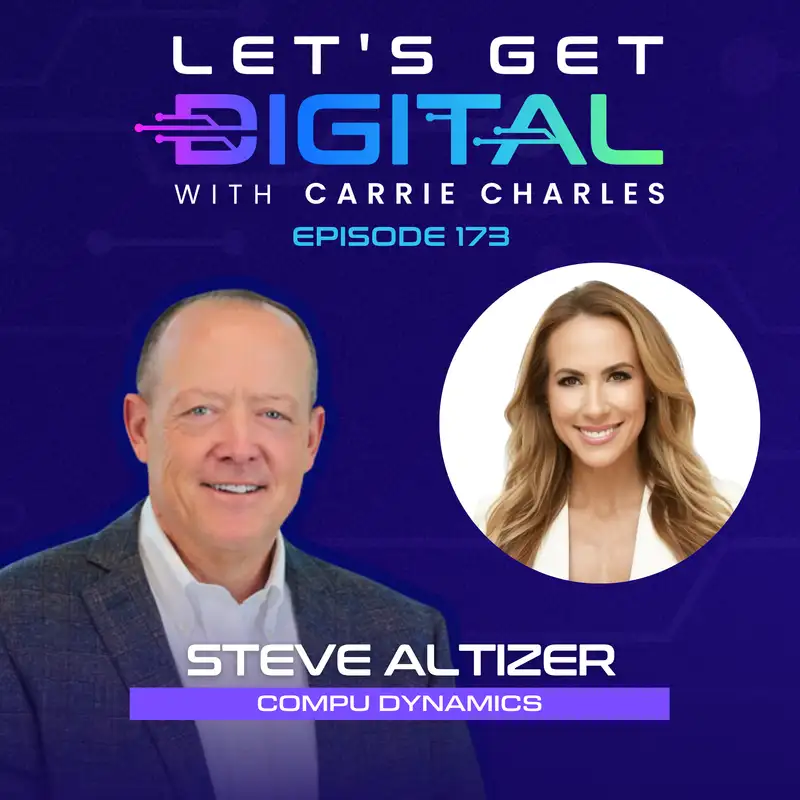
Carrie Charles (00:01.447)
Welcome to Let's Get Digital. I'm Keri Charles, your host. I'm glad you're here. And I'd like to introduce you to my guest for today. His name is Steve Altizer. He is the founder and CEO of Compute Dynamics. Steve, thank you for coming on the show.
Steve Altizer (00:16.278)
Hi. My pleasure. I don't get the chance to do this very often. It's really, it's going to be fun.
Carrie Charles (00:22.479)
I know, I'm so glad that you agreed to come on. I think we met at Data Cloud and spent a few minutes together. And I am just really excited to tell your story and also the story of Compute Dynamics. So let's start with you. How did you get into this amazing industry that we're in? And also, I'd like to know the founding story of Compute Dynamics.
Steve Altizer (00:38.23)
Okay.
Steve Altizer (00:49.556)
Okay, maybe I can wrap those two together.
I was in engineering college, the worst engineering student ever. I barely got out. So no engineering firms wanted to hire me. I became a contractor. And I loved construction ever since. And around 1999, I was with a big general contractor here in town in the DC area. And the boss said, why don't you go do something in technology? And so I ran into this data center opportunity and just kind of fell in love with data centers. 1999.
And we grew really rapidly for about a year, a year and a half. then of course, history will tell you the bubble burst and everybody went bankrupt and that ended rather abruptly. But two years later, I started my own company and we started with a data center. I was back in the area that I loved and I wanted to be...
a little holder construction, know, Holder, the granddaddy of all data center builders, and I really wanted to be them one day. I think at one point I was, I calculated I was one thousandth the size of Holder. I think we were about a million and a they were about a billion and a half. But after a couple of years we morphed,
We became a mechanical contractor over a weekend. We worked this out ahead of time, but there was a company leaving town. They wanted to lay off their service team. We took them. They left on a Friday. We started with them on Monday. They had trucks and tools and uniforms. And so we were in the mechanical service business over the weekend.
Steve Altizer (02:18.51)
2007-08, we became an electrical firm, bought a company that did electric work, bought another company in 2011 that did more electrical, became really deeply entrenched in the electrical field. That was about the time when things were moving from on-prem into colo in a big way, and there was a thing called wholesale colo, and we started doing what's now called white space integration or white space fit out work, and that became sort of our bread and butter over the coming years. We started doing low voltage work, got a secret clearance.
built on our general construction heritage a little bit with recruiting some additional people. So we're one of those weird companies that does a little bit of everything in the data center business. We could build anything. We're very entrepreneurial. If we see something, we go for it.
2025 was a good example. 2025, we started an AI HPC service unit, which is crushing it right now. We also started a modular business, which I'm sure we'll talk about here in a moment, which is we have the traditional construction side in CompuDynamics. Now we have CompuDynamics modular, which is building data centers in a factory. And it's so exciting because we got all the bases covered, but I think everything is moving in the direction of modular construction. And so I hope we're ahead of the game a little bit.
I just don't see any need to build million square foot buildings for 100,000 square feet of racks. And I think things are going to start moving in that direction.
Carrie Charles (03:42.957)
So you said you do a little bit of everything. Let's go into detail there. I mean, you're fully end to end life cycle. When you say everything, you mean everything, right?
Steve Altizer (03:55.448)
Pretty much, we self-perform electrical, mechanical, and low voltage. We have a general construction business. We really do service, maintenance. We love the design side, so we love to do design build. So anything from the back of a napkin concept to long-term operation and maintenance of a building, we can do everything in between. we started, I've been in construction and I've been in service.
I like service, even though some people look at us as a construction company. Service is where you take care of people, you fix things, you're nice, you have a good relationship with your customers. Construction is where you beat them to death and you try to take all your money, all their money, and they do the same to you. But so I've always liked service and we look at ourselves as a construction services firm first. And when you're in service, you try to do as much as you can for your clients.
Carrie Charles (04:44.499)
Yeah, so you recently acquired a manufacturing company to build modular data centers in-house. Why was owning the factory such a strategic move and what does that unlock that others can't do?
Steve Altizer (04:58.69)
Yeah, it was pretty important. We started the modular group before we bought the factory.
And everybody we were talking with said, hey, we like what you're doing. Let's come visit your factory. We didn't have a factory for them to visit. We were engineering and marketing and sales and no factory. We were using other people's factories. That's a bit of a sham, frankly, because you're not, you're stacking margins on top of margins. You're never going to really be competitive that way. So we found this organization in Texas that wanted to move from oil and gas into data centers.
And we arrived at each other's doorstep at the same time. And we love those folks. We acquired them on January 1st. And they are our modular manufacturing outfit. We can, at the end of the year, we're expanding their production capabilities now. But at the end of this year, they'll be able to put out 500 modular buildings a year. That's two every work day. And that's pretty enormous. So I think we'll even go beyond that at some point. But that'll get us where we need to be for the next 12, 18 months, I think.
Carrie Charles (06:01.737)
12, 18 months for sure. mean, this is just like a rocket ship. Everything, feel like, right?
Steve Altizer (06:08.608)
It feels like a turn-based. feels like, yeah, you know, people talk about speed and scale. Cost is important, but it's not as important as speed and scale. And so what we've been doing is trying to fast track everything. You know, the things that keep me up at night are, can we actually get there? Can we reach our potential?
Are we going to be able to scale as much as customers need us to? I don't know the answer to that. We're trying as hard as we can. We have a huge project in Texas right now. We're working seven days a week, 24 hours a day to finish that project. And we're going to be there for another couple of months working on it. And that's how important speed is to people. And everybody in the modular business is saying, yes, so we like your product. You can build one or two of these, or can you build 1,000? And that's a question we hear all the time.
We'll just see how we do.
Carrie Charles (07:01.203)
So what problems are you solving with Modular that traditional data center, they just can't solve or can't keep up with? What's different?
Steve Altizer (07:10.7)
Well, it's, you know, even the most modern AI data centers today, if you look at them, they look like
very industrial looking. They're not beautiful necessarily, but they have a bunch of modules stacked on top of the building. The building is where the IT gear goes, but the building is still there. It's still a physical building. It's either a concrete building or it's a metal building, but there's a building there. And if you look inside that metal building, you're still going to see a bunch of tradespeople climbing on ladders and up and down on lifts and putting things together piecemeal. And to me, that just doesn't make sense. If you're going to modularize your design, why don't modularize the entire thing?
the white space too. And so our focus at CompuDynamics Modular has been trying to lead the industry toward modularizing the white space. Nobody really was into that for a while. Everybody's doing powerhouses, e-houses. That's where all the modular people are now and they're all booked up for the next couple of years. They're not even thinking about getting into anything new. So we're looking at the IT space and trying to modularize the IT space, the white space, which kind of goes hand in hand with what CompuDynamics has been known for forever, where white space companies
we can build it in a stick-built fashion, we can do it in modular fashion. But I think AI made that possible. We never could do that before AI. If you try to put a cloud white space into a box and ship it across the country, it's not going to work very well. There's just not much mass to it.
You know, don't have the water piping that you do now in an AI liquid cooling environment, the four massive busways, all of the conveyance, all of the structural containment. All of this makes it very interesting and perfect really for modularization and factory prefabrication. So I know other people are thinking about it. I don't know how many people are getting into it, but we see ourselves as sort of one of the leaders in that business. We're going to be fighting with Schneider InverTiv and a lot of other people are getting into it, but
Steve Altizer (09:05.954)
we're going to be the underdog. And I think we've got a pretty good solution.
Carrie Charles (09:09.789)
When you say white space, can you go a little bit deeper there for people who don't know what that means?
Steve Altizer (09:14.924)
Yes, it's funny, kind of assume everybody knows, nobody. Yes, well, data centers are built in stages. Traditionally, a data center is a big box, right? And there are generators and transformers and chillers outside.
Carrie Charles (09:17.917)
They may, they may.
Steve Altizer (09:33.11)
And then once you get inside, there are lot of UPS systems and switch gear. And then there's this box where the IT equipment sits. It's walled off from everything else usually. It's the customer space. It's called the white space or the data hall. Inside the data hall, data halls are customized for every tenant.
If you're a hyperscaler, you're not going to want to use somebody else's white space. Microsoft won't use Oracle's, Oracle's won't use Meta's, everybody's got their own preferences. So historically, every white space has been customized anyway. And so what we're doing with the white space is it's quite easy to customize a module. It's really hard to customize a building. If you're going to customize a building, you've got to start 18 months ago. But if you're going to customize a module, you can start last week and start forever.
next week. So it's quite easy you just have to change your power distribution, change your water pipe size, how you're going to distribute liquid cooling in the box and then get to town. So it's I think it's going to be faster, ultimately it's going to be way cheaper, it's going to be more efficient because you're not cooling an entire building envelope. Our one to three megawatt unit is 600 square feet.
It could be 4,000 watts per square foot. And you just don't see buildings built to that density today. But that's the survey eye. I think we're doing what is needed today, but we're also looking for tomorrow and trying to be ready for tomorrow.
Carrie Charles (11:01.736)
Speaking of tomorrow, you talked about speed and some of the things that keep you up at night. What are some of the challenges that you see with delivering these projects at scale?
Steve Altizer (11:14.539)
You know,
scale. That is the problem, scale. One of things that we're doing about that is I really think that even if we had a thousand units of productivity a year that we could get out of our own factory, that wouldn't be enough. We are just a small, small percentage of the overall data center requirement to serve AI and it keeps growing exponentially every year. So the scale question is the biggest challenge we have. And what we're doing is we're working with our own team and
trying to maximize the throughput in our own factory, but we're also working with partners. So we have relationships with some of the biggest contract manufacturers in the country who are already interested in building data center products. They already do 80 to 90 % of their business as a contract manufacturer. And so when we get a situation where we need more than we can produce, we can turn an opportunity over to them and they can be our high volume producer. it's, this is the way it's supposed to work and we will see if it does.
have a lot of optimism. think I love our partnership so far and it just depends on where the industry is. We're ready for it.
Carrie Charles (12:22.554)
I think you're right. We need to work together. Not one company is going to make this happen. mean, we need partnerships. I think that's going to be the way it's going to be executed, really. It's true.
Steve Altizer (12:36.844)
Right. Another thing that concerns me a bit is the supply chain.
I don't know if you want me to carry on a little bit further on that, I'm actually very concerned about that. There are a handful of manufacturers that make breakers in the world. There are a bunch of firms that make switch gear, but they're all at capacity. There are UPS products that are being introduced, but if you ask them to reserve a product for you, you can't get it until 2027 or 2028. And so I am quite concerned about the ability to get products to a site in time to get the data center functioning.
Carrie Charles (12:43.994)
Yeah, let's go. Let's talk about it.
Steve Altizer (13:11.664)
But what I think has been true in the data center business historically is when there is a constraint.
and it's preventing somebody from getting the GPUs online that they want to. People work around that. They find a way to do without it. For example, there are AI data centers being built today with no generators. Generators take a year to get, so don't even use them. are data centers being built today with no UPSs on the server side, maybe on the network side, but not on the GPU side. So people are just skipping over that and not using it. And eventually, we're going to be looking at
high voltage down to medium voltage to DC power. And a lot of this switch gear issue goes away because it's a whole different ballgame at that point. Different product sets, different manufacturers. So I think the people that are leading today might not be leading in the future unless they get on the bandwagon and start developing future products as well as current products.
Carrie Charles (14:13.426)
Boy, we sure do need to get on that bandwagon fast. So you're not just building data centers. You're maintaining them for up to 20 years or longer.
Steve Altizer (14:22.67)
Well, we provide services sort of indefinitely, know, at data centers.
Carrie Charles (14:26.898)
Okay.
Steve Altizer (14:28.782)
Today's data centers haven't been around that long. The most modern data centers that were built in 99, very few of them are still actively operating because they were built to such low density. But those that are operating, we can help customers take care of them. We have a crew of maintenance technicians, electrical mechanical people that take care of equipment. We don't do a lot of building operations, but we could and we have at times supported clients that way. But the whole idea is just to not...
win a project, build it, and then walk away for five years. We want to win a project, build it, and stay with the customer and just be available to them as they need our help. We are pretty good at this. And if they're going to find somebody to help them with the maintenance, why not us? Once upon a time, our motto in this company was, why not us? A long time ago.
Carrie Charles (15:16.432)
I love it. You know, does that change the way that you build and design from the very beginning or design and build when you really have that long-term vision of maintenance?
Steve Altizer (15:29.612)
Well, I think the maintenance people would appreciate it if we did. Yeah, I hear this all the time. It's great when a customer's operations team gets involved in the design and certainly in the construction, because there's so many things that can happen that would make it very hard for a building to be properly maintained.
Carrie Charles (15:32.262)
Yeah
Steve Altizer (15:46.368)
leaving access for certain things. It's really critical and the time to find out about this is not after it's built and operating that you know if you can't maintain it that's going to be a bit of a problem. it's good to have sort of a maintenance mindset when you're doing design and construction because then you know what's going to happen after you're gone and you can sort of plan for that.
Carrie Charles (16:07.952)
So when companies grow quickly, the culture often gets diluted. What intentional decisions have you made that protect the culture at CompuDynamics and also, again, could, could transform even as you scale. Tell me about that.
Steve Altizer (16:27.756)
Yeah, I think culture.
Our culture hasn't changed a ton since the beginning. I think it's been rather consistent. We're a really high integrity company. We have culture, we have values, you know, we have a mission statement. We have all the buzzwords that people talk about, but it's all about who you recruit and how you treat people. If you recruit people on their talent alone, that could be a mistake because they might be jerks. And I think we have a company of really wonderful people, but they're also talented.
been very lucky. Sometimes, you you picked the wrong person, but you can't avoid that at times. But I think if you fire fast, as they say, hire fast and fire fast, you can make up for that. But I think it's all about making sure that the people are easy to get along with first. I think about this is a little bit like when my kid was playing lacrosse and talking to lacrosse coaches and the coaches would say, you know, you can't teach somebody how to be six foot three and 240 pounds, but you can teach them how to throw a lacrosse ball. So
You can't teach somebody how to be nice and respectful, but you can't teach them how to manage a project. So we try to find good people first, and then if they lack any skill, we'll try to fill in those blanks. Yes. Good way to say it.
Carrie Charles (17:44.498)
Hire character first. Yes, yes. Speaking of hiring, there's bottlenecks with labor right now in the data center space. It's only gonna get worse as time goes on. What are your thoughts around the labor shortages? Is there anything that CompuDynamics is doing to, like you said, define good quality people, training talent?
Steve Altizer (18:09.824)
Labor is only going to get worse as a problem with the data center industry. heard a gentleman from Crusoe speaking on a panel last week at GTC, and he said they had 9,000 tradespeople on the Stargate project in Texas. Well, you can't expect that on every site around the country. It just can't happen, because they were bringing people in from 40 states. So you have to grow your own at times. What we're doing to sort of grow our own was we're hiring young people and trying to teach them.
hiring people that are being taught by others, but we're really looking to start with the trades. I think a lot of our future depends on the trades. Of course, at the same time, we're dealing with the modular future and looking to reduce the amount of trade content, labor content in a data center, but that's a different model altogether. But in the traditional compu dynamics business, we're trying to recruit from organizations that have already identified people who want to work
I'll give you an example. Northern Virginia Community College is an institution that we really, really respect.
They bring students in, thousands of students in, who need to succeed. They don't just want to succeed. They're working two jobs and they want to advance themselves. So they want to learn and they want to get a better job at the end of their schooling. And those are the kind of people that we want to hire. And so we work with them quite a bit through, we're working with them on a scholarship program right now. We work with them on internship programs. We've raised $200,000 for their school over the last six years. There's another one I should
mention, I really like this organization in Alexandria where I live. Just met him recently. The guy grew up and he had a hard life growing up. Lots of disadvantages, but he was able to...
Steve Altizer (20:00.366)
emerge on the other side and make himself successful. And I respect him so much. He's trying to give back to the community. And so what he's doing is teaching young people the trades ages 12 to 17. I think they graduate when they graduate from high school. But a couple of times a week they'll come in and he'll teach them how to hang drywall, how to run an electrical circuit, how to do plumbing. And then when they get out,
They have a skill and they're proud of themselves and they have self-respect and they have confidence and those people will not be left behind. They will have opportunities and we're recruiting from them right now actively because they have a class coming out in a couple of months and we're looking forward to hiring some of their people.
Carrie Charles (20:43.429)
He needs to scale that all throughout the country.
Steve Altizer (20:46.306)
That's going to be rather hard to scale, but yes, they don't make people like him anymore. I was communicating with him the other day and I said, I want to be like him when I grow up. He's just, I respect him so much.
Carrie Charles (20:55.655)
well, so what do you think about Modular? Do you feel like this is the future of data center builds? What do you see here as a vision?
Steve Altizer (21:13.42)
Yes, well for certain data center builds, there are people that would say the cloud's always going to be around and co-location and on-prem and other things. are various versions and flavors of data centers. But in the AI space and wherever AI goes after this, I think it's going to make perfect sense to build these factories and the components of these factories, excuse me, build these data centers in factories. It just makes no sense to have people climbing on top of people.
that the infrastructure is so dense and the number of different trades involved is ridiculous. And you can do it more cost effectively with higher quality and have the modules ready to be installed at the site when the site is ready. So I think what we're going to find is in a very short period of time, the really dense high performance computing facilities are going to be built a different way.
So those who are building tilt up panels and structural steel buildings and massive envelopes, I think they're going to have their opportunities. But I think in the AI business, it's going to be more industrial. We're going to be building.
manufacturing plants. That's why they call it an AI factory, I think. We're going to be building factories for tokens. And when you're building a factory, you don't need a big open building. You just need a production space. And what we're doing is building high density, low volume production space. mean, high volume, but low space volume. Yes.
Carrie Charles (22:42.883)
So Steve, when we look back a decade from now, what do you want people to say that CompuDynamics changed about the data center industry?
Steve Altizer (22:47.085)
Yes.
Steve Altizer (22:56.45)
I don't know, that's a lofty goal. know, we are, like I said, we're just a speck in the market. We have such a small...
market share relative to the total data center world. It's nice to be known. We are pretty well known in some circles, but I think I want people to think of us as a very high quality organization with great people who tried hard and did great work. We were innovative. We were on the cutting edge, not necessarily beyond the cutting edge, but we're right there where they need us to be when we need to be there. And
You know, we are a tech company. We're drinking the Kool-Aid. We're ready for the future. We're ready for customers who want to do high-tech work. And I think we've got the skills to do it. So, and 10 years from now, we'll see if we succeed in being there where they need us. But that's my goal. Yes.
Carrie Charles (23:48.335)
One more question, because we heard about what keeps you up at night. What drives you? What makes you jump out of bed in the morning?
Steve Altizer (23:55.15)
Just this industry in general, I'm not a spring chicken here. I've been in this business for quite some time, but I have so much excitement and energy about what's happening today. I was telling somebody yesterday, I wish I were 25 because I want to see this business for the next 50 years. I want to participate in it. I don't know that I'm going to make it that long, but I really want to be a participant because there's so much happening. It's so exciting to be in the data center business.
Carrie Charles (24:23.959)
It is, it is. mean, every day, every single day, it's like something changes, something's new. Steve, thank you. Thanks for coming on the show. This has been fantastic. I know I'll see you again at another event coming up, but I sure do appreciate it.
Steve Altizer (24:32.526)
Thank you.
Steve Altizer (24:39.67)
My pleasure. Thanks for asking me the questions. It's been fun, just like I expected. Appreciate it. See you.
Carrie Charles (24:43.975)
Take care.
Don't go anywhere. Let's stay here. Let's stay here. Let me see.