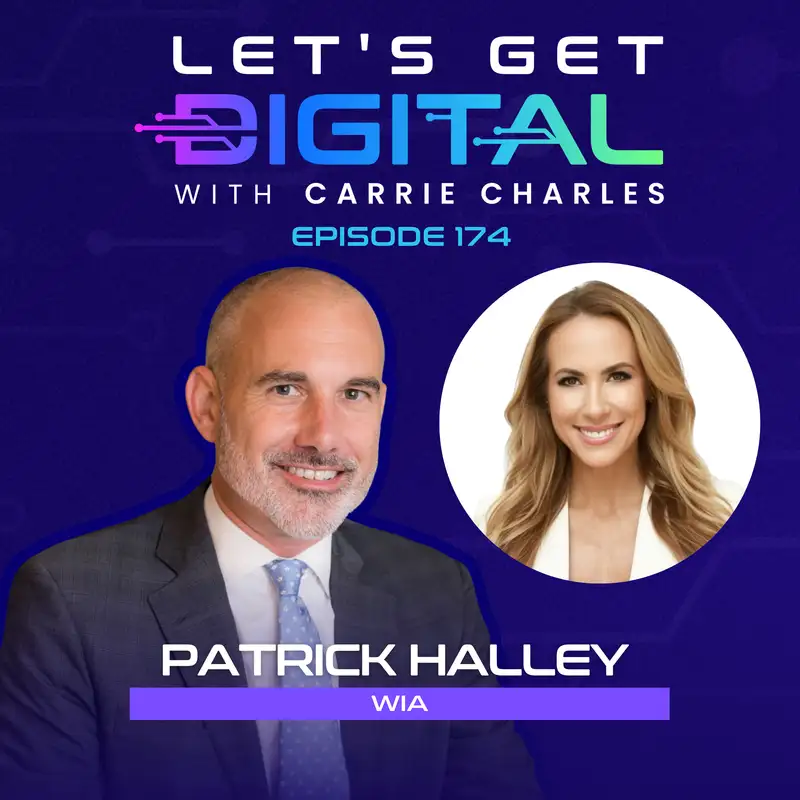
Carrie Charles (00:00.938)
Welcome to Let's Get Digital. I'm Keri Charles, your host. And today I have with me Patrick Halley. He is the president and CEO of the Wireless Infrastructure Association, also known as WIA, where he leads the voice of more than 140 companies building, owning, operating the wireless networks that power our connected world. Patrick, thank you for joining me today. You've been on before. I always love to hear your insights.
Patrick Halley (00:28.492)
That's great to be with you, Kerry. And you don't even need hype music when you're being interviewed by you. You just bring the energy yourself. Great.
Carrie Charles (00:33.452)
I love it. I just think I exist like this all the time. So let's start with a big picture for those who don't know WIA. What does the Wireless Infrastructure Association do? Talk a little about its membership and also your role.
Patrick Halley (00:51.79)
Sure. So WIA represents the companies that build, own, operate, and finance the infrastructure that powers wireless connectivity in the United States. If you're connected to a wireless network, whether you're in your car, in a stadium, or just walking around the streets wherever you may be, you are on a network that's being powered by infrastructure that our member companies build. So it's tower companies, small cell providers, people doing in-building wireless. It's the wireless carriers, it's the OEMs, the Nokia's,
Ericsson's the Qualcomm's of the world and then it's all of the companies that support all of those companies and actually doing the building doing the permitting Doing the engineering analysis, etc So it's the whole ecosystem and it's really truly a privilege for me to run an organization who advocates on their behalf and in terms of what we do to to Make opportunities possible for our members, which is what we're all about. It's advocacy at the federal and state level and in the courts It's training and education
It's convening, putting on great events like ConnectX, which is coming up in May in Fort Lauderdale, Florida, which I hope we'll talk about. And it's doing research and just promoting the importance of our sector and everything that we do and that we enable.
Carrie Charles (02:04.98)
So WIA recently distributed its wireless infrastructure by the numbers report. So what trends really stood out to you and why? And what recommendations do you have for the industry based on those?
Patrick Halley (02:20.023)
I think what stood out to me is that even though the nature of wireless network deployment is cyclical.
that there still is just this consistent demand and investment in the infrastructure necessary to power wireless networks. Now that level of investment and the level of deployment varies depending on where you are in any given deployment cycle, as we all know. But this year there was $65 billion in wireless infrastructure investments. And we're not at the top of any investment cycle, as many of your listeners will surely tell you. But that said, there was still, when you count the operations and capital
investment in the wireless infrastructure sector. We're talking about $65 billion. That total was actually up about $2 billion. We're talking about 158,500 purpose-built macro cell towers in operation in the U.S. That's up over 4,000 from the year before. So we're still seeing new builds, right? Certainly we're seeing wherever possible, we're seeing colocation on existing towers, and that's the whole business model that powers this entire industry. At the same time, we are still seeing
some new builds. But I think the thing that stands out to me more than anything is you still have a massive amount of CapEx and OpEx being spent on this sector. You've got new builds, you've got co-location, and it's because there's always this incessant demand for more data. And the only way you can possibly meet the demand for more data is if you have the infrastructure in place to make it possible. So that's what stands out to me. As far as recommendations, I've got a lot, Kerry.
But I mean, look, on the policy side, I think we just have to keep educating people about the fact that there is no 5G, there is no 6G, there is no Amazon on the go. None of it is possible without that infrastructure. So it's just consistently telling the story, which obviously we spend a lot of time doing, and then pushing for what I think are just really common sense policies to make more spectrum available and to make it available as quickly as possible. And then also to put reasonable and responsible national
Patrick Halley (04:27.291)
framework into law, which we're spending a lot of time on, our mantra is predictable, proportionate, and transparent. And I think that's what every business and every government should want, and that's what we're trying to get done when it comes to the permitting processes. And then the final thing I would say is, you know, what recommendations do I have for our industry? I think it's the fact that...
Wireless infrastructure is AI infrastructure. I say it all the time, but I think it's important for our industry to recognize how AI in the network is affecting the way carriers and tower codes and others are operationalizing and creating efficiencies in their business, but also how AI on the network, the services and applications that are riding over these networks, how AI is already and will undoubtedly affect deployment going forward and recognizing that we need to get our head around that right now so that we're planning for the next 10 years.
over the next two years.
Carrie Charles (05:23.116)
So WIA also recently distributed its newest market study, the Wireless Pulse of American Life and the New Frontier of AI. What are the most important takeaways of that study?
Patrick Halley (05:34.946)
I think it's the fact that we're already seeing at the end of last year, 4.2 % of total wireless network traffic is from AI.
we think that that number probably looks closer to like 10 % by the end of this year. That AI in some form, again, whether it's AI in the network or AI on the network, that the traffic on wireless networks is gonna be coming from AI in one form or another, and that's a lot. So I think that's a big takeaway. The other thing I think, and why, is one of the stats, because we did a consumer survey, and effectively 60 % of US adults said that
they are using AI and they're using it on the go on their mobile device. Right. Think about think about what you do with your phone now. Simple stuff like asking Chachi PT who won the college basketball championship this year. It was Michigan. Go blue for those who are or doing more complex computational things like taking picture of an empty flower pot and saying OK I want to understand I live here. I want to plant flowers that I don't have to do much with and then it's
going off and doing a computation and giving you a full recommendation for what to do. That type of stuff is what you're doing and you're doing it on your mobile phone, right? When you're thinking about going to ConnectX, today you're probably getting on your laptop or at least a year ago you were and searching, you where do I want to stay? What are the flight options? What hotel? What restaurants? Booking my VIP pass. You might have done that on a laptop.
Now you're doing it on a smartphone and next year you're probably going to use an AI agent and you're literally just going to talk to your agent right into your phone and you're going to say, I want to go to Fort Lauderdale. These dates, I want to fly out of Baltimore, Washington International Airport. I want a hotel within a quarter mile of the venue. I don't want to spend more than $350 a night and I'd like to have a steakhouse reservation on Tuesday and an Italian reservation on Wednesday. Give me options.
Patrick Halley (07:41.411)
Like that fundamentally that kind of activity is increasingly happening over a mobile device. And it's not just basic stuff. It's real sort of more complex reasoning that the network has to do. All of which means more AI over the network, more AI over the wireless network, all of which is going to continue to increase the demand on those networks. And for us, I think what comes out of that is, well, what does that look like two years, three years, five years, 10 years from now in terms of the
spectrum that's needed and the infrastructure that's needed to make that possible.
Carrie Charles (08:15.724)
Gosh, you seem to describe my life. I just talk into my phone and do exactly what you said. I feel like it's all day long.
Patrick Halley (08:22.722)
Well, you're one of the, they talk about having like three different levels of AI. There's sort of the resistor. These are the doomsday people who think it's the worst thing ever and not do it. And then there's like the hyper users, which maybe you are, which kind of really accept it and they're taking advantage of it. And then there's most people are probably somewhere in the middle, which is what you might expect, which is sort of trying to understand it, make sure we're taking advantage of it for good and avoiding some of the pitfalls.
Carrie Charles (08:49.322)
Well, one thing we know for sure is the wireless industry is right at the, I mean, in the middle of all of that is what you're saying. And that there is, I mean, you're bullish on the future. I can hear that, right? I mean, what does the next five years look like for, let's say the, you know, the services companies, the contractors, the, you know, the companies that really need the projects in the wireless industry.
Patrick Halley (09:15.086)
I'm.
I'm always bullish. I'm also a realist. You know, I'm not going to sit here and tell you every day is the best day in our industry because there are challenges and I'm aware of that. And I know even right now, many people continue to face challenges. Frankly, that's been true the last couple of years. But I am bullish. And the reason I'm bullish is because there's a fundamental recognition of the importance of wireless connectivity for the consumer, for the enterprise. There's a lot of manufacturing that's going on right now that's just completely wireless.
then that's going to increase. So on the enterprise side, I am definitely bullish about the use of next generation, know, 5G advanced networks and then 6G on the horizon. On the consumer side, same thing, you know, we still have 14 million homes. We already have 14 million homes that are 5G home broadband. We think it could be 30. And as that number continues to increase, it means we need going to need more spectrum for more homes to be wireless connected. So, you know, it's sick.
We've talked about this before, it is. And we're sort of on the tail end of the infrastructure build part of 5G. Not necessarily the tail end of 5G being useful, right? We now have 5G standalone cores that all the carriers have. We're seeing network slicing, we're seeing capabilities in the 5G networks that weren't possible a couple years ago. So there's still a lot of benefit to be gleaned from 5G. We're already starting the standards development conversation for 6G. That demand, mean, John,
John Stanky at AT &T, had this quote talking about entering an AI hyper growth phase where he expects data on the wireless network to increase by like 80 % over the next five years. So yes, I am bullish, it's in my nature, but it's also because I do understand that there will be another cycle. There'll be another cycle after that, you know, and we will be freeing up more spectrum over the next five to 10 years. With that spectrum will become a lot more infrastructure deployment.
Patrick Halley (11:15.392)
macros, small cells, everything in between. And I think at this point, we're just really focused on making sure that we do have that spectrum available, that we do have permitting processes in place that make it so that projects get deployed and not bogged down. And if all of that pans out and if AI really truly does start fundamentally impacting how our networks operate in a way that I think they will, I think we're going to be in a good place.
Carrie Charles (11:41.92)
So can you give us an overview of the telecom policy landscape? Where are we now and where do we need to go from here?
Patrick Halley (11:49.903)
So we're in an interesting place. We are, I'll just break down some of the key issues, right? So one is spectrum, I've been talking about it. We passed a law and by then, within the next 10 years, we have to make 800 megahertz of spectrum available for full powered wireless use. That's the good news. The bad news is we have to figure out where that spectrum comes from. And so it's not bad news, it's just a challenge. And so we're figuring out whether it's the seven gigahertz, the four gigahertz, 2.7 to 2.9, these different bands that are currently being
used by other entities, primarily federal government agencies. The good news is we will have an auction by July of next year, so just over a year from now we'll be getting ready to auction somewhere between 100 and 200 megahertz of upper C-band spectrum. So it's just above where the current C-band, which was obviously quite a boon for our industry, we'll be auctioning another 1 to 200 megahertz of upper C-band spectrum and then that will get deployed. So the spectrum debate is very active and very live and what we're trying to do
is come up with ways in which we can have really wide spectrum swaths. So like 400 megahertz channels, if you will, in some of these bands to really be able to take advantage of the capabilities that we're seeing on the future. So spectrum, big topic. Permitting. We're hoping soon that the House of Representatives takes up the American Broadband Deployment Act, which is effectively codifying many bipartisan FCC decisions over the last 10, 12 years to make it so that the permitting rules are predictable at the national level.
that so that we have, you know, we really truly do value the role that local governments play in the permitting process. We just want it to be predictable and timely. And so we want shot clocks. We want to have projects go forward if there's no action taken in a certain amount of time. We want fees to be cost based, right? Things that I think are pretty common sense. And we're making progress and we hope to have legislation passed the House soon, fingers crossed. At the same time, we're working on it at the state level. We just had a bill passed in Virginia signed by the new governor.
their governor Spanberger to do exactly that at the state level. So that's a big topic. You know, and the commission is doing a lot at the federal level to try to make it so that the carriers, the big companies in our country like AT &T and Verizon and T-Mobile and others, that they're deploying and spending their capex on fiber and on wireless, modern next generation wireless connectivity, as opposed to the old copper networks of the past, for example. So that's been a big topic of debate, among other things. And that's just a sample. There's a lot.
Patrick Halley (14:19.562)
As you know, I'm sure you're aware, we've been spending a lot of time trying to make sure EchoStar does the right thing and pays its bills. So I would call that a fairly niche issue, but one that's very important because, you know, let's face it, when a company gets to spell spectrum for $50 billion, and the only reason they're at the table selling it in the first place is because of all the companies that stepped up to build that network for them, they ought to pay those companies who got them to the dance. So just a sampling of issues.
Carrie Charles (14:48.446)
Yes, couldn't agree more. So let's talk about ConnectX. This is your flagship event every year, and I go every year. I think I've been going every year for the past 10 years, as long as I've been in the industry. I look forward to it. It's really our biggest event. Tell us about it. Where is it? What date? And how do we register?
Patrick Halley (15:10.38)
Yes, all of this can be found at connectivity expo.com. We will be in Fort Lauderdale, Florida from May 4th through May 6th. It's going to be a fantastic event. Literally the entire digital infrastructure ecosystem will be at ConnectX. I'm really excited about the content. I'm really excited about the level of interest that we're seeing. I think it's going to be a very well attended event. We're feeling very bullish on ConnectX this year.
We'll have a satellite partner summit on Monday where the chief of the space bureau at the FDFCC will be speaking along with other satellite companies. Obviously a hot topic directed device and other issues in terms of the role satellite plays in our ecosystem. Here's the footnotes. It's very important. It's supplemental, but it's not a replacement for terrestrial infrastructure. We'll have a connected spaces track, kind of a conference within a conference throughout the event for those
who are really interested in the in-building conversation, including a connected venue summit looking at the way wireless is improving the fan and player and team experience in sports. And then we'll have a bunch of tracks that really focus on the regulatory policy and technology and business issues of the day across the board. I'm really excited. We've got Srini Kalapala from Verizon. We've got Robert Walters from AT &T. We've got the COO of Digital Bridge.
some really great panels looking at Edge AI. I will say this, I don't think we've ever had Nvidia and Intel on the main stage at ConnectX, but we will this year, which I think is reflective of the conversation we had earlier, this sort of intersection between AI and infrastructure at the Edge becoming much more of a real conversation. And so we're really excited about it. It's going to be great.
Carrie Charles (16:58.912)
I cannot wait. So Patrick, we've seen thousands of layoffs across wireless, I mean, just in the last, even the last year. I am hearing that the next wave of hiring is coming. We've seen at Broadstaff that it's picked up a little bit, but who knows? From WIA's vantage point, what is the real state of the workforce now? Are we going to see hiring pick back up? Is there any way to predict that?
Patrick Halley (17:29.582)
Bye.
I think the only way to honestly answer that is to say it depends on over what time period you're talking, right? So I'm glad to hear you say that you're seeing hiring pick up. I hope that's the case. I will say candidly that the one number that was down in our infrastructure by the numbers report was number of employees in our sector. And it was down by about 27,000, which is meaningful. Right. And I'll say it again, but it's true. you know that this is a cyclical industry in the
in the sense of, you know, there's this incredible amount of deployment at the front end after spectrum auctions and as new Gs get rolled out. Clearly we're on the back end of that cycle for 5G and that has meant, you know, impacts on the employment side when it comes to wireless infrastructure and all of the many firms from construction and services and engineering and environmental and permitting and everything else. No doubt that there's been an impact and the numbers say that.
But I don't think that that's gonna be the case several years out. I think we're gonna slowly build back up as we complete the 5G build out and then as we get into 6G. And it also depends on kind of how you define the ecosystem. If we're talking about tower climbers, yeah, we're down. I can't say that we're not. And there are challenges that have been unearthed around sort of the entire...
landscape when it comes to the construction side of tower building and there's important conversations being had about trying to improve that market. But if you look more broadly, so take for example our registered apprenticeship program, we have 16 registered apprenticeship occupations from tower climber one to tower climber two to tower foreman, very tower focused, to multiple occupations inside and building to fiber installer, aerial and underground fiber installers, to fiber technicians, to last mile broadband connectivity.
Patrick Halley (19:29.328)
installer. So there's a lot of different occupations and some of them are actually booming. So it just kind of depends on how you look at the landscape. We're, for example, working on a project in state of Texas where we are working with the University of Houston, but that whole project is about fiber techs. And when you talk to the metas of the world and everybody else in the data center side, there is an insatiable demand for fiber techs right now and electricians and other occupations to try to make sure we have enough fiber that's going to get connectivity to every data center and
and also to the demands of bead, is primarily fiber. And so there's a lot of demand there. There's certainly a lot of demand for some of the build out going on with data centers as well.
And at some point, things will flip and there'll be a lot more going on on the wireless infrastructure side like there were maybe three years ago. So the reality is, as you know, there's been some layoffs and it has been challenging. But I do think that there are opportunities if you widen the aperture a little bit and if you look a little bit further out.
Carrie Charles (20:30.102)
Can you talk a bit about the Telecommunications Education Center through WIA and give us some updates there? What is it? What kind of impact do you make? How can companies and people get involved?
Patrick Halley (20:41.494)
Absolutely, great question. So it's kind of a microcosm of what I talked about with our registered apprenticeship program. Our goal there is to provide training for enterprises or to partner with two and four year schools so that when folks can take a series of different trainings that we offer and come out with a certificate, that's wireless and fiber again. We are offering the fiber optic path training course
in our partnership with FBA. So we're doing a lot of training on fiber. So if you're a business that wants to train fiber techs,
capable of doing that. As I said, we're doing it in state of Texas and elsewhere. But then we also have a lot of courses that are good for entry level folks, folks who are new to the industry just getting started. 5G 101, Spectrum 101. We have some new courses on Satellite 101 and AI to try to make sure folks have a fundamental understanding of what those technologies are and how they work. So I think we have a really representative and quality product. And to the extent folks want to take a look, we're always happy to talk.
Carrie Charles (21:48.076)
So it would be a great idea for a company who's hiring new talent with no experience to get them registered in one of those 101 courses, right? So they can get up to speed quickly.
Patrick Halley (21:57.294)
100 % and we do bundles with certificates. So you're doing a sort of a combination of Spectrum 101, 5G 101, wireless infrastructure 101, AI 101, you sort of get the full landscape. So at least you're conversational and understand the overall basic concepts. When people are talking about them, you know what they mean. With all the accolades, all the accolades, absolutely. You can be an MVP if you take our course.
Carrie Charles (22:14.954)
with all the acronyms that we love so much. So Patrick, one more time, how can we learn more about WIA? How can we register for ConnectX?
Patrick Halley (22:27.222)
So just visit wia.org, wia.org, and for the show go to connectivityexpo.com and I hope to see you there.
Carrie Charles (22:36.938)
You will see me there. Thanks for coming on, Patrick. I always love our conversations.
Patrick Halley (22:41.034)
Absolutely. Thanks for having me, Kerry.
Carrie Charles (22:44.522)
All right, that was awesome. Sit tight, don't move yet.