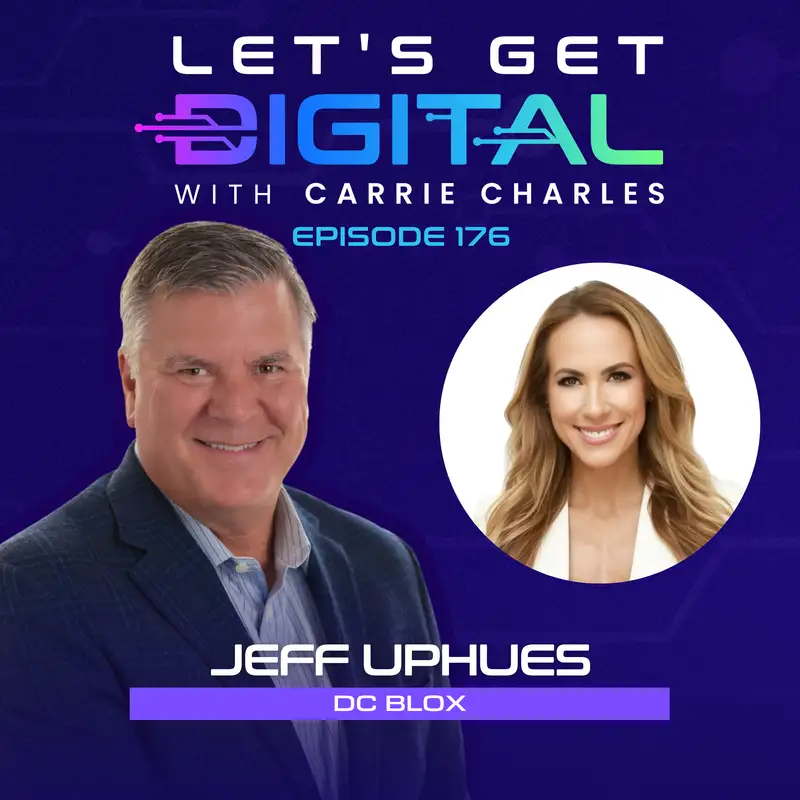
I am so glad you're here with us today on Let's Get Digital.
I have a great show for you, so stay tuned.
My guest today is Jeff Uphuse.
He is the CEO of DC Blocks.
Now, DC Blocks has a different way of building digital infrastructure, so you wanna stay
tuned and hear all about it.
Jeff, thank you for coming on the show.
I can't wait to get started.
Thank you, Kerry.
It's good to see you.
Thanks for having me on today.
Of course, of course.
So I always like to start out by talking a little bit about you.
So tell me about your story, what led you to the CEO seat of DC Blocks.
Yeah, well, it's a...
It's been a lifelong journey.
I've been in the communications sector and industry for a better part of 35 plus years.
Started in my early days, way back in a company called Will-Tel, where we started running
fiber optic lines through uh gas pipelines and really progressed in my career over a lot
of different areas.
ah Came up through some just fantastically run companies like C Beyond and others, and
then got to know the banking space really, really well.
ah I helped a former CEO do an LB
oh of a managed global hosting company.
uh And then I really said I wanted to be involved in uh the data center side, which was a
part of our business.
uh And I started looking for what was next.
So I was introduced to uh some investors who had originally put some dollars in commitment
into DC blocks.
That was in the May of 2016.
I met them in the summer of 2016 through some bankers that we all know in our industry
really, really well that had
referred me in and said, hey, if you're looking for a board member, you probably ought to
talk to Jeff.
One thing led to another.
became an advisory board member in September of 2016.
By the end of the year, it was, hey, Jeff, do you have a team that potentially can really
scale this idea as it's going to need a lot of horsepower to do this, and you get a great
track record and a great team?
And about $5 million had gone into the business then.
So it was really small.
I mean, it was like no data centers yet officially on the ground.
So I talked to my team, which was uh made up of some guys who I'd worked with a long time
ago and uh in a previous venture.
I've always believed that if you find people who are really, really smart and you find
that they're really good at what they do, find ways to keep working with them.
So I pulled together a team and we jumped into the seat of the CEO in March of 2017.
And now we're uh amazingly entering, uh it's now nine and a half years about ready to go
So it's been a hell of a ride.
So tell me all about DC Blocks.
I want to know what makes you different.
Just give me the whole story.
Yeah, sure.
Well, I would describe DC Blocks as how we're different.
Number one, it's focus.
Focus that we've always believed that, you know, if you if you go an inch wide and a mile
deep in a market, you get to know those markets better than anybody.
And if you look at the markets we've taken, this is really spent most of our careers all
throughout the southeast United States.
So if you come from an area where you know deeply, where you're connected, you know the
culture of the communities, it was a great place for us to really build a business.
So we really started that in the Atlanta area and then said, you know, we're really going
to be a Southeast focused company.
I've run companies and done things before where their scale and size is all over the
United States or all over the globe.
And it's just really difficult to try to manage things on your executive team and others
and connect with customers on a localized basis in doing so when you get spread too thin.
Plus we were early stage and we said, hey, look, we're going to have to prove ourselves
starting out.
made us different is, you know, we focused on really three things.
Number one, was serving locally and connecting globally within the markets for which we
decided to enter.
And we had mapped all those markets really, really closely of which ones in the Southeast
did we feel we'd have the greatest amount of success in doing.
We knew that if we were coming into Atlanta and we only had five million dollars that had
been invested in the company, uh people probably wouldn't give us the, uh you know, the
right type of credit.
it even though we had great track records, the company had not yet established itself.
So we said we're going to go to the underserved growing markets and we're going to build
the best purpose-built asset we possibly can in those markets and when we go into it we're
going to have not only the best facility in a data center but we also said that
If we win the hearts and minds of all governments, all universities, all enterprises, all
carrier accounts, all content, all cloud companies, anybody coming in and out of there,
eventually we would win the hearts and minds of hyperscale companies.
And we always knew that that was going to be the approach.
So we started with that simple approach of we're going to go in and be the best company we
can be and dominate in Chattanooga, Tennessee, in Huntsville, Alabama, in Birmingham,
Alabama, in Greenville, South Carolina.
and all the surrounding markets.
And when we knew how to compete, we built things on time, in budget, we operate them, we
sell customers, we build a good business that we'd be ready to expand even further.
And so now we've kind of fast forwarded ourselves.
We do three things really, really well.
As I mentioned, we started with no data centers in beginning of 2017.
Today we do hyper-scale build-to-suit facilities that range from 40 megawatts to 200
megawatts.
We do hyperscale edge facilities, including cable landing stations.
Those are really network nodes that are interconnecting the large-scale hyperscale
campuses together on behalf of the hyperscalers.
And then we do high-capacity hyperscale fiber that connects our campuses together.
So this vertically integrated digital infrastructure is really what has led us to where we
are today.
And it's just amazing.
We're in eight states today.
uh
We've got 12 data center campuses.
We have 11 of those, 12 under construction or under development.
We have five more, including a gigawatt campus that is also in the works.
And when you raise from 5 million to now 2.6 billion and another 2.2 billion in the works,
we've developed a lot of square footage, which is approaching over 2 million square feet
that we have under some level of development.
So it's been a great journey.
You know, when you're talking, it reminds me of that book, to Great.
I've read it probably, I don't know, 20 times, but what a success story, Jeff.
Congratulations.
Yeah, well, I've learned a long time ago that if you listen to your customers and you do
what they tell you to do, you're probably going to be pretty successful if you continue to
focus and build an organization that is driven around customer success.
And we've done that a lot with just our culture as well uh as the way that we operate.
And in DC Blocks for us, it's always employees first.
Because if you have happy employees, they'll take care of your customers.
And if you have happy customers, they'll take care of your investors.
And it's trying to put more simplistic things around it.
As business gets complicated enough as it is, just treat people well and try to exceed
everybody's expectations all the time.
And then when things don't go right, then you just have to be in a position to own up to
it and work through it collectively.
I don't think of those as problems.
I just think of them as puzzles.
They just need to be solved.
Wow, a lot of wisdom there, a lot.
Amen, Jeff.
That's good.
So DC Blocks, you talked about that you build hyperscale campuses, edge nodes, subski,
fiber networks.
I think, I don't know if I missed something, but how do you, how do all of these pieces
connect and why did you choose to build the full ecosystem rather than just one layer?
Well, I think we did it one at a time.
when the way that it really started was as we said, if we started with these smaller
centers, and when I say smaller centers, they were typically on property acreage that was
between 10 acres to 30 acres.
And when you did that, you said, well, where are you going to start?
You're not going to build the full capacity of a data center campus right out of the gate
without having customers in it, because we started some of these just on spec.
We didn't have any customers when we started.
We had to start from ground up.
So we started small.
And then we systematically started increasing the amount of property of what we were
buying that would allow for you could put a edge.
data center, call it 1 to 5 megawatts or 1 to 10 megawatts.
and have excess property next to it that you could put a 40 megawatt data center in the
future.
And so when we started thinking about the smaller end, was start small, build up, build
success.
And then we came across a pretty unique opportunity, which was a cable landing station,
which frankly is just another fancy word for saying it's a data center.
And we won this contract with its public knowledge.
We won it with Google and then added in Meta.
And we essentially have now built the largest cable landing station on the eastern
seaboard ah that uh houses international cables.
It's got one from South America, it's got two going to Europe, and soon to be uh one that
is the first transatlantic cable to ever land in the United States off the coast of Africa
that also connects over into Asia.
So by doing that, it put us behind the veil with a lot of these hyperscalers, and we
continued with this same approach.
of, well let's just go buy a little bit bigger campus and let's buy a campus that could
have that same 10 to 20 megawatt size data center on it, but then have something that you
could put hundreds of megawatts on next to it.
And it was that same strategy that just got a little bit bigger and a little bit bigger
and a little bit bigger and a little bit bigger that led us into these bigger campuses.
And then finally, uh you know, one of our customers said, hey we have this puzzle that you
need to
we're trying to solve, is how do I get connectivity from your cable landing station to
large facility in Moncks Corner?
And then how do I get that into Atlanta?
And then we just started anchoring data center campuses all along our fiber.
So we had a digitally integrated uh infrastructure platform.
So it kind of grew into it.
wasn't by design day one, everything, but we just more or less morphed into it and said,
OK, well, how do we make it just a little bigger?
How do we make it a little better?
How do we make it
by listening to your customers, right?
That's the secret.
That's it.
Let's focus a little bit more on the fiber.
How does owning the network change what you can deliver to the customers?
Well, number one, you have owner economics.
ah
When you're looking at the data center infrastructure today, everybody says, my gosh, look
at these massive campuses.
And many people forget about just the fiber that uh is now being required.
It was that long haul fibers, you were leasing 12 pairs, 10 pairs, eight pairs of fiber to
customers.
Now, uh on our route, we have pulled a 432 count, we've pulled an 864 count, and about
ready to pull another 864 because the fiber quantities of what customers want
have just exploded and when you see the size of what they need the only way you would ever
be able to do that is if you had conduit systems that you built in the ground that had the
capacity to handle it.
So I think the only mistake we made was we probably didn't put enough conduit in the
ground on the initial leg just because the amount of fiber that is now in demand is just
massive.
Massive is the right, maybe even an understatement.
It's crazy what's going on right now.
uh And let's look at digital infrastructure and where we've been for decades, it's been
expanding.
What has changed now since AI has been really pushing that demand to a whole new level,
like something we've never seen before?
Yeah, that is...
It is evolving.
It is evolving and evolving really, really quick.
I kid around with our board sometimes.
said, remember back when, when we were talking about that half cabinet or full cabinet of
the orthodontist or this small physician's office that was in, we've seen the business
explode from cabinets to rows, rows to cages, cages to data halls, data halls to
buildings, and now buildings to campuses.
And in that approach, it is not only been
in.
the growth of what we've been seeing in cloud, but AI has fundamentally changed the way
that designs have to be deployed.
we have some, said to me the other day, said, well, Jeff, you have a front row seat.
mean, you do, you do business with the likes of, you know, all the hyperscalers and who
they are.
And I said, I said, well, it's not that we have a front row seat.
We're on the court in the game and being on the court in the game, you have dynamics that
come at you all the time.
So I.
say that being on the court, you the top five hyperscalers, we know all what their designs
are.
But those designs also change based upon the deployment of what application or what
customer they want to put in there.
Some of it is for their own use.
So if you say, have something for, I'll use an example, Google Apps, or you're using
something for just Meta on Instagram, or you're using something for Microsoft that is on
Office 365 or Azure, or using something for Amazon.
on, you know, those are traditional cloud apps.
The apps that many of them are doing now is they're all partnering with everybody else,
mainly all of the Neo clouds.
So you see announcements that come out almost every every week.
It's like, well, Coreweave partnered with this hyperscaler or Anthropic partnered with
another hyperscaler or OpenAI partnered with yet another hyperscaler or we're going to run
this low density application or this high density application.
You have to have the flexibility
in your design engineering teams to accommodate almost every application that a customer,
and meaning your large hyperscalers, may or may not use.
And you have to be flexible enough to handle liquid cooling.
You have to be flexible enough to handle closed water loop systems.
You have to handle these in different voltages.
who uses UPSs?
Who doesn't use UPSs?
Where do they have uh generators or generator light systems versus heavy generator
systems?
Where does gas
behind the meter come in if you can't get electrical grid in quickly.
There's so many different elements of the designs and all of that is really being driven
by the hyperscalers need to push compute out faster and push it out for different
customers.
Let's talk about energy for a bit.
We know it's one of the biggest constraints in the industry.
How are data centers evolving from just pure energy consumers into infrastructure that can
possibly support a broader economic ecosystem?
Well, the energy in today's world is getting difficult and harder and harder every day.
ah There is a race to where you can get electrons and power.
it often always comes to where do you have the transmission grid?
Where do you have the ability and who has the electrons that they can get to you in a
timely fashion?
uh Which states have nuclear?
Which states have more gas?
Which states have uh more access into uh either bringing behind the meter or providing you
the type of power ramps of areas what you need?
And so much of it comes down to what regulatory and legislation is being done by the
public service commissions.
You know, we're headquartered in Georgia and you may have seen Georgia has just put out
through Southern Company a 9.9 gigawatts of new capacity that is coming on into the market
and it's about a third, just under a $30 billion investment that is being done by Southern
Company into adding more capacity.
And that's predominantly just to serve the demand of data centers.
So as data center operators, now we have to step into much more of
the economic side of doing that, which is very, very costly.
I'll give you one quick example.
In one market, I won't mention which one it is, but in one market, we went to the utility
and said, hey, we need 216 megawatts of capacity.
And this is two years ago.
And they said, okay, great, we can do that.
You need to put in a 50 plus million dollar deposit upfront for us to build a substation.
So remember, the largest check we had ever written at one time as we continually grow, the
largest check we'd ever written to anything at one time was about
$5 million in building a facility.
Now we have to write a check for $50-plus million just as a deposit for utility to deliver
three years from now.
So we leaned in, we did that, we have a customer.
Fast forward 12 months from then, we have another property that is literally next door.
So you have one with 216 megawatts, you have another one with 216 megawatts.
The power utility went from $52 million to north of $400 million that you have to invest
up front.
So it's become a financial engineering exercise is what you've also had to navigate as an
operator.
How do you do this on behalf of your customers where you have timeline to power, you have
the right electrons in the right time when you can get it there, you have the right
ability from transmission to get it in and out of the facility, and then you have to have
all your infrastructure now
that also handles different aspects that could be variability and load and how it may go
up and down versus a standard constant load, the nature of AI.
So oh it's complicated.
How are you doing it?
uh We've got a fantastic team.
When we've made these shifts from when we were really small and we're building these
smaller facilities to where we are now, we just had to materially change and staff and get
the best of the best people that we possibly could from engineering, uh everything from
data centers to cooling systems, uh from energy substations to...
to behind the meter gas, to how can you run transmission and ensure that you're
understanding the loads of what is taking place in transmission and find areas.
then really had to staff uh a robust land team as well, not to mention all the other
things that you have to do just to deliver facilities.
So it's uh been a lot of lessons learned, but like I mentioned, we built a great company
based on culture and pillars that uh
are foundational for our customers.
It is really, really about the people.
Would you mind sharing some of those pillars, your cultural pillars?
Yeah, absolutely.
So, you know, we believe in four things and number one is transparency.
Because if you're transparent with people and you tell them all things, you tell them the
truth, you say, hey, here it is, just an open book in your approach.
Transparency over time builds trust.
So if you have transparency, which is the first T, you then have trust as the second T.
Trust has to be built internally and externally.
It has to be built with your peers and also has to be built with your customers, has to be
built with your communities, has to be built with legislators, has to be built ah up and
down the stack, especially with investors as well.
If you are transparent and you build trust, the only way to achieve anything is through
teams and teamwork.
So the third T is T for teamwork.
And when you're building
the right team, what we've learned long ago is I'm a big sports guy that still acts like
an athlete, although my body's a lot slower than what it once did.
ah You look at it and say, individuals can win games, but teams win championships.
It's always team before I, and continue to keep thinking that.
And then the last thing is you gotta work your tail off.
And we call that tenacity.
And the tenacity is every day you attack the day like you have something to prove.
And every day you have to attack the day ah because nothing comes easy in life and you
have to continue to just put in the hard work.
today, most of our people are putting in still an enormous amount of hours, but they know
that we put them first because we put them first, they'll take care of our customers and
those customers will take care of our investors.
So it's these uh four
of transparency, trust, teamwork, and tenacity that really is the foundation of what we
do.
And also I heard that DC Blocks has been very intentional about educating communities.
So why is there so much misunderstanding still about data centers and how are you changing
that narrative across the Southeast?
Yeah, Kerry, that's one that you really have to understand.
I'll give you an example.
Going into like Alabama for the first time and building a business, now we have three
centers in Alabama, one in Birmingham, one in Huntsville, and one in Montgomery, Alabama.
And you had to learn the culture and it's about meeting people where they are.
So if you walked into a meeting and you're talking with legislators or you're talking to
people in, in general assembly, or you're talking to people in city council, or you're
talking to the neighborhood across the street, you better understand that the first 40
minutes of any conversation is, you Alabama or are you Auburn?
And then you get into meeting the people where they are.
And it's just about having, it's just about being genuine.
I mean, you can't fake being genuine.
And I can tell you, we run into the same thing, whether we're in South Carolina, it's
like, are you a Clemson fan or South Carolina fan?
Or, you know, if you're in Georgia, are you a dog fan or are you a Georgia Tech fan?
And you continually go through these and you can take...
different elements of loyalties and where people are aligned to build a lot of
understanding to what is important to them.
Like I'll give you one more example that is around a community.
One community we went into and they said, Jeff, what's really important to us is you help
us with a sports park and we want to understand what you're doing.
So I'm like...
Okay, well, how is this going to benefit a data center was my first thought.
But then I said, well, we'll hear the people out.
Let's meet them where they are and understand.
And meeting them where they are was they're a bedroom community.
They're outside Atlanta.
They have many of the trade workers that are building construction, doing things all over
Atlanta.
There's no places for them to have parks for their kids.
They want to have data centers into the environment because they feel that that can the
tax dollars can really help in the school system.
And if you have things with the kids can go after school
and you can have a regional sports authority with a park.
then we can attract more neighbors into the community and be the type of uh community that
really serves Atlanta or outside of Atlanta in a great place to raise a family.
And once you start explaining things like that, you go, it all makes sense.
And so whether it's getting into places and saying, hey, I need to do help in the school
system in Alabama, or they want us to do help in uh an incubator for a city that is
different and they're trying to move more towards technology, or it's
How do get engaged in uh community initiatives that are there that are passion led by
people in the staff?
It's genuine from our staff and it's genuine by us really understanding what's important.
And that has morphed into now when we go into these communities, people really find the
way that we are transparent from the beginning.
We answer their questions.
It's not with a bunch of technology speak.
It's just with open book answers of, well, let me understand your concerns.
meet person by person or group by group or town hall by town hall.
And you have to invest the time and we've got a remarkable team that does that.
But we all lead from the front.
We're all out there and just willing to take anybody's questions.
You know, it's way more than just bringing jobs to the community.
I mean, you're, you actually become part of the community and part of making the community
better in so many ways, right?
Well, that's the objective.
The objective is that the amount of tax dollars that can be derived from a data center
itself.
I mean, we've gone in and bought brownfield sites that were off the tax rolls within
cities by partnering with cities and counties.
And by doing so, now you take a piece of property that's been dormant and dead on the tax
rolls, you immediately put some life into it.
You then put a data center onto it that is tens of millions to hundreds of millions to
billions of dollars of infrastructure that is going in.
and then you have the personal property tax, which is all the computing infrastructure
that goes in that gets refreshed every three to five years, that is also there for uh
personal property taxes for those counties.
And then you can start seeing the impact of what that has on the school systems, what that
has on the tax base in the community.
they're just amazing can happen when people really understand that.
So Jeff, there's a real problem with workforce shortages in the data center world.
I mean, it's just going to get worse over time.
uh A big bottleneck.
Where are you feeling the pressure most with your teams and what is DC Blocks doing to
build and sustain a talent pipeline?
uh Great question.
um For us, we hire a lot from culture first.
I people can go anywhere.
And when you have an opportunity to go anywhere, I I saw an article uh from Jim Rowe, the
guy who is uh the construction guy.
says, my gosh, there's people that are plumbers or electricians that are now getting paid
$260,000 a year without a college degree.
And they're getting poached from one company to the next.
You know, when you lean into your employees and you lean into your partners who you're
building things with, that makes a difference.
When you are, it's the little things.
I continue to keep going on to the simplicity of things of how we operate.
And the simplicity is you just treat people the way they want to be treated.
And if you do that and you put them first,
We have almost gotten everybody who's ever come to DC blocks and the vast majority of the
team has never left because we've always treated people right.
And we do that and extend that into our partners of who we use, whether that be a GC or
whether that be the underlying trades that work with them.
And it's that family approach that you truly can get in Southern states or what we operate
in SEC territory.
So this is really how we operate.
I don't know if that works if you're saying, let me go do this in Chicago, but it
certainly works across the states with what we're doing and trying to bring talent in.
We've always had a very successful uh opportunity to, uh a lot of success in bringing
people in, but I do feel that we need to put a lot more education into our trades.
Somebody like Nomad Futurist that is doing a bang up job of trying to get out there and
educating the workforce.
ah
They've done great and I think that many vocational and technical schools, we need to do a
better job as an industry to really help train those people.
Yes we do.
m I believe that your that your strategy would work all over the world.
I mean it's like you said it's just so simple of of taking care of people and treating
them with respect and I mean I just think we all need to be that way really right.
Well, it's about at the end of the day, you really just want to make a difference in our
world or at least the people that I know we surround ourselves with want to make a
difference in the world.
And it's not just in the work that they do, but it's the communities that they serve.
And ah people with a good heart and a good head have all the opportunity in the world if
they find the right environment to really push those agendas.
uh
So let's look ahead a bit.
What is your long-term vision for DC Blocks and how do you see the digital infrastructure
space evolving, let's say, over the next decade?
You know, the size and scope of what we've grown at the pace for what we have grown oh is
what we refer to as beautiful insanity.
It is crazy to see what happens.
Growing at the same pace over the course of the next five to 10 years almost seems
uncomprehensionable.
But, you know, when you look at it today,
If you build a system and you build a process-driven company, I still think DC blocks can
continue to to evolve and grow and add more and more facilities.
They're getting bigger.
As I mentioned, you know, we now are evaluating a couple of gigawatt style campuses, but,
you know, break those down into, you know, if it's a thousand megawatts, it's like, well,
that's just 10, 100 megawatt buildings, or it's 20, 50 megawatt buildings.
and you can handle it because you don't try to do it all at once.
I think for our industry and the growth, I don't really see an end in sight.
You have different cycles for different customers.
So you've got all of the top tier hyperscalers that are growing in at a really, really
fast pace.
You now have many of the AI and the Neo clouds that are out there that are growing at a
really fast pace.
It has left a void in where the enterprise fits because all the capacity for power and
space has been gobbled up by the hyperscalers and the Neo clouds.
Where's the enterprise going to go?
And so the ability of where one group is maybe slows down a little bit in capacity and the
other group speeds up in capacity uh and that dynamic of just evolving technology.
I think we've got a really good runway for the next five to 10 years of continually growth
in building our facilities.
uh We continue as a company to invest back all the capital of what we bring into the
facilities and all the capital that we return.
it back into new facilities.
So, you we have a long runway ahead.
ah We think that the market is continually going to be solid, but you have to deal with as
much of the fluidity that happens ah and you have to be able to adapt because as soon as
you think you have something in one way, it might change on you.
And you have to be able to adapt and stay fluid with the customers and how you're treating
them.
And right now, I don't see much end in sight.
And I think DC Blocks has got a great trajectory for the next five to 10 years.
Jeff, this is one of those episodes where I just want to go back and listen and take
notes.
So much gold here.
Thank you for coming on the show.
And uh I can just feel your passion and everything you're doing at DC Blocks.
And I'm sure there's people listening that really want to come work for you right now.
I know I do.
Yeah, you know, we have a lot of openings.
continue to hire.
think we hired 10 people last month, and so we're going to continue to keep going as our
customers need us to.
ah But thank you, Kerry.
It's really good to see you, and I appreciate you having us on today.
Of course.
You take care.
We'll talk soon.
Sounds good.
Thank you.
Okay, stop there, don't leave,