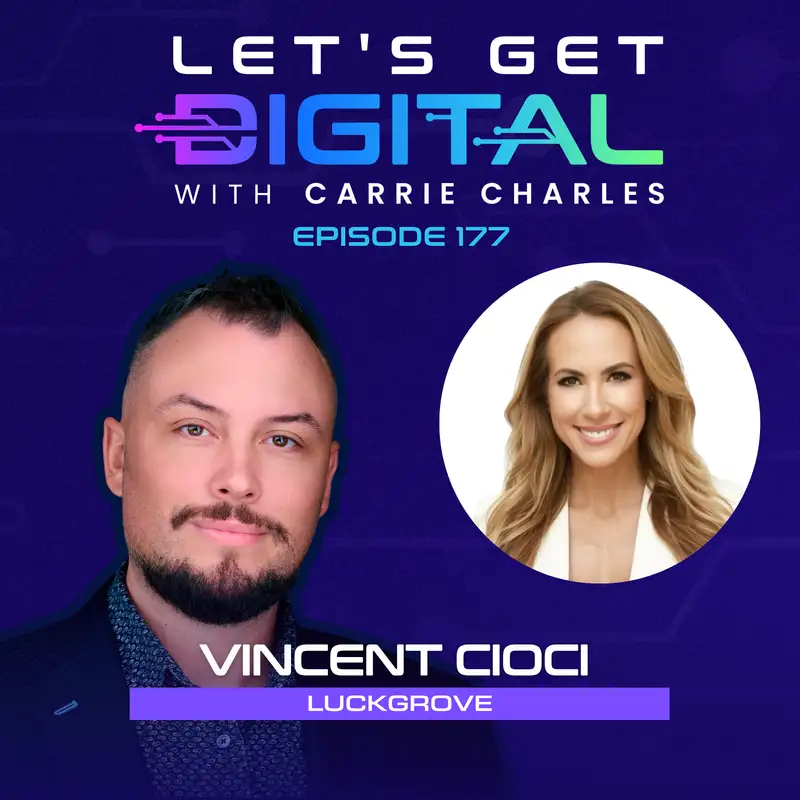
Welcome to Let's Get Digital.
I'm Keri Charles, your host, and we're gonna have some fun today.
I have an amazing guest for you.
His name is Vince Cioci.
I heard him speak recently, actually, I don't know, maybe even a year ago, and I said, you
have got to come on my show.
He is the CEO of Luck Grove, and you're gonna hear a lot more about Luck Grove.
They are revolutionizing telecom and utility spaces.
So, Vince, thanks for joining me.
Carrie, thank you so much for having me.
I just wanted to say before we get into everything, you know, we really appreciate you,
what you and Broad staff are doing for the industry and for Luck Grove.
So thank you.
So I get that out of the way first before we dive in everything else.
Thank you.
We just love it.
We love it.
And this is a lot of fun too.
So Vince, I want to hear your story and what got you into the fiber, the utilities world,
what made you just fall in love with telecom?
course.
um
So a little bit about me, was born and raised in Long Island, New York City area.
I'm the oldest of eight kids.
I was homeschooled up until college and ended up going to school in Oswego, New York as
upstate.
My entry into fiber wasn't something I'd planned out at all.
I don't think anyone grows up wanting to be a telecom engineer or construction
professional.
It just kind of happens to you.
uh After graduating, I was working in uh restaurants and the food manufacturing industry
when I met Mike Roberts.
He introduced me to telecom and the
way I always describe it is like...
stepping into the wild west.
There was a lot happening, a lot of opportunity, not a whole lot of structure at the time,
um which for me, I thrive in chaos, so was very exciting.
What really pulled me in m was the idea of building something real, like physical
infrastructure that people rely on every single day.
It's extremely exciting being able to see us be able to create that.
um So at that point, I'd already had one sun and another one on the way, so it wasn't the
safest move to just drop everything and jump in, but I did.
I started as a 1099 field surveyor, learned the business from the ground up.
Mike mentored me and Joe Roberts mentored me and over time I worked my way into leadership
roles and then eventually into the CEO role.
So that's where I am today.
What an inspiration.
So field surveyor to CEO.
I mean, yeah, go ahead.
uh fielding poles, lot of freezing cold mornings.
But it gave me uh the opportunity to appreciate what.
what we are actually doing out there.
And then, you know, also getting involved in some construction tasks as well before I, you
know, eventually got into leadership roles.
You know, not everybody gets to experience that from the ground up.
And uh I'm glad I did because it gives a true, uh you know, appreciation for what our guys
are doing and our people are doing out there every single day.
So.
Yes, yes, I love it.
So tell us about Luck Grove, a little bit about the founding story and what you do on a
day-to-day basis.
no problem.
So Luck Grove was founded in 2008 by Joe and Mike Roberts, a father son team.
um Joe had a really unique background.
He started digging ditches for the Bell system and then put himself through night school,
became a lead engineer and eventually worked on major telecom infrastructure projects
internationally.
So he was actually working for um the kingdom of Iran before the Ayatollah came in.
And then he was working for the king and queen of Thailand.
So he was he was working on some really
cool large scale projects uh a little before his time, you know, he was really just a
pioneer in that realm.
When he came back to the US, he partnered with Mike Roberts, his son, and started Luck
Grove uh right as fiber was starting to begin traction.
So that was 2008.
um Early on, the company was small, very execution driven.
We built a reputation for ourselves by doing work the right way and just delivering uh
consistency and...
been a great product.
when I joined, I think there was about three employees when I joined.
um But we saw how large the opportunity Fiber was going to become.
we made a very intentional decision to build for scale.
That meant bringing engineering, construction, operations capabilities in-house and
building the internal structure to support growth.
And you always hear me harp on that all the time.
But it's truly the building pillars that we had to put together to be able to experience
the growth.
that we have.
So today Luck Grove is a fully integrated engineering and construction company supporting
fiber-to-the-home deployments, MDU build outs, and now we're expanding into hyperscale
data center environments.
So fiber expansion feels like it's really entering a new phase right now with bead
funding, new investment.
I mean, it's on fire, right?
And then the data center boom as well.
What are you seeing on the ground that gives us visibility into the next five years?
So.
Carrie, I look at it like we hit half time and we're heading into the second half of the
big game.
So, you know, the first phase was all about speed, building as fast as possible.
You could throw a dart on a board and, you know, we're building there today, you know, if
you're the ILAC or the ISP.
ah So covering as much ground as possible.
I'm seeing now we're seeing a shift towards, you know, finishing the job.
That means filling in coverage gaps, going deeper into existing markets, activating
infrastructure that was already built, but not fully utilized, you know, like the MDUs
leaving the drop coil.
behind and then going back and revisiting those opportunities.
So, uh you know, on the ground we're seeing engineering activity ramp back up, more
planning is happening, and operators are positioning themselves for the next phase.
ah You know, there's still massive amount of work left to do, so from our perspective, the
next five years remain very strong.
It's not slowing down.
I think it's just becoming more focused and more strategic now.
You know, it's interesting because the industry, from what we felt, slowed down for a bit
while construction caught up.
And so what you're saying is the fiber build, you know, that whole space is entering a
real acceleration phase.
I mean, are we, are we ready for this?
you
I don't think we're ever ready for any of these builds, but we try our best to be.
I think we're right on the front edge of it now.
Engineering is active across a lot of markets and that's always the leading indicator.
Once designs are complete, permits are clearing, construction follows very quickly after
that.
um What we're seeing now is a backlog of projects that we're waiting on approvals starting
to move forward.
And when they move, they're large scale deployments that require coordination, execution,
all that good stuff.
So I don't think it feels like a slow ramp.
I think it feels more like a strategic, like a release of pressure.
So, you know, at the same time, it's more controlled than the first wave with a stronger
focus on strategic builds and execution.
It's time.
It's time to go.
So we talk a lot about fiber, but you're also seeing growth around MDUs and hyperscale
data centers.
So how are those opportunities changing the kind of work that your teams are doing?
And also for those who don't know what an MDU is, maybe just explain that.
There's a lot of acronyms in our industry.
Of course.
So MDU, MDU stands for multi dwelling unit.
So you think apartment buildings or multi tenant.
It's, know, MTU, MXU, MDU.
There's a million acronyms for everything, but, know, just think multi tenant unit, think
multi, you know, commercial unit, et cetera.
So major opportunity right now.
We're just starting to fully tap into it.
There's thousands of buildings that were passed during the initial fiber builds where
service loops were left, but buildings were never fully built out.
So, you know, providers are going back and targeting those properties, which creates a
more detailed and hands-on type of work.
You know, everything's nuanced when you get into, you know, actual customer facing type
stuff.
you know, we're currently, we are currently working on one of the largest MDU deployments
in the country right now.
Luck Grove is doing a turnkey construction model on that.
And it's proven to be uh quite an experience.
It's amazing.
It's great.
So we expect that type of work to become much more common.
um
you
On the hyperscale side, uh very exciting shift.
A lot of the same transferable skills that we've learned over the years working fiber to
home, ah but a little more specialized, you need a little bit more experience when you're
working with the amount of fiber cables and splices and the structure cabling type
diagrams and layouts that you have to do.
again, I believe that the fiber to home, the last fiber to home big deployment really
prepared us
to start handling these types of jobs.
So, you know, we're still early in that.
We do have a few projects that are underway, but we are expecting that to grow very
quickly.
So one of the biggest constraints in the industry right now is what I talk about all the
time is workforce and talent.
How serious is the talent shortage in fiber world and data center world and what roles are
you seeing are the hardest to fill?
So it is the biggest issue in the industry right now, hands down.
I have.
Something written down here.
The U.S.
needs roughly 350,000 additional construction workers just to meet this, the demand just
this year alone, 2026, and over 90 % of firms are struggling to hire.
So, I mean, if that doesn't say something, I don't know what else will, but, you know, and
that's not just telecom, that's across all the construction and infrastructure.
So there's a major gap between the amount of work available and the number of qualified
workers.
So, you know, when projects move,
move aggressively because everybody's competing for the same labor pool.
So the hardest roles to fill are, you know, experienced engineers, project managers,
skilled crews, and specialized technicians like the data center splicers that I had
mentioned earlier, and other low voltage professionals in the MDU space.
So it's not just a hiring issue, it's a pipeline issue.
So Luck Grove built an in-house engineering school, you told me about this, that can take
someone with no telecom background and turn them into a fiber engineer in weeks.
So how does that work and why was that so important to you to build that capability
internally?
So that came directly from that workforce challenge that we were just talking about.
think we realized early on that we weren't gonna be able to hire our way out of it.
So we built our own pipeline.
uh We bring people in with strong computer skills, specifically for engineering.
We bring people in with strong computer skills, work ethic, the right mindset.
And even if they don't have telecom experience, we train them internally.
So we are essentially minting telecommunications engineers and designers.
ah
mentors, folks who've been in the industry for a long time, know, like the Mikes and Joes,
and we combine them with the internal systems that we've developed at Luck Grove, and then
actual real project exposure.
We put people on real projects so they are learning on the job as they are completing
tasks.
you know, with the right structure, we've been able to develop productive
telecommunications professionals much faster than expected.
I mean, like I said, we went from three employees to well over 200 engineers in a very
short amount
time and that was just due to the you my my awesome team and implementing that that
quote-unquote school you know telecommunications engineering school so major advantage for
us but we're applying that same model to constructions not always you know construction
engineering sometimes we're like oil and water but we're trying to trying to bridge the
gap with some of the skills that we've learned when um when training oh our engineers.
You know, Vince, this is one of the solutions.
Obviously, this is not an easy problem to solve, the workforce shortage that we're
experiencing now.
But I think that training programs internally, I mean, it is, you we have to go there
because we just simply don't have enough people in the industry and we can't keep just,
you know, poaching people from one another, right?
So we've got to bring in new talent, make more.
copy, paste, copy, paste.
That's what we gotta do.
And you know, one day Vince, it would be so nice if I can, you know, talk to a guest on
the podcast and they don't say I fell into telecom or I, you know, accidentally got into
fiber.
I really want it to be, no, I planned this and I, you know, I wanted to get into the data
center world and digital infrastructure and fight like someday that's gonna happen.
But I do think that what you're doing,
is what every company needs to do no matter what size is to build these internal training
programs.
So hats off to you.
absolutely.
We're all in this together at the end of the day.
We all got to get the job done.
There's plenty of work out there for everybody.
So I encourage everybody to, you know, if they're not doing it already, definitely do that
model.
I mean, you know, it's a way to go.
So culture seems to be a huge part of your growth strategy.
When companies are trying to scale quickly and in a competitive labor market, what does it
really take to build a culture where people want to stay?
Right.
So, you know, culture is a major focus for us, you know.
There's one thing compensation always matters, of course, but beyond that, people want to
feel like they're part of something, know, part of something big, growing, feel valued and
actually enjoy where they work.
You know, we try to create an environment that balances serious work with energy and
engagement.
So that includes everything from internal events like the holiday cooking deck, holiday
cookie decorating that we do, which is fun.
Courtney loves to put those together to competitions, you know, with we have video game
competitions in office for like actual decent
sized cash prizes and team driven activities, stuff like that.
you know, a lot of that is driven by our HR team.
Again, Courtney Walker is the best.
you know, she's, we're just very lucky to have folks like that that can uh foster a, an
environment that everyone feels like they're having fun, but also getting the job done at
the same time.
So we've seen these crazy hype cycles before in our industry.
Do you think this new wave of funding and bead will actually complete the job or are we
setting ourselves up for another cycle of overbuild and slow down?
So what's interesting to me right now is that the industry is already active.
um So there's engineering underway, projects are moving, and real demand is driving the
work forward.
So this next phase isn't dependent on Bead.
It's already happening.
But what Bead does do is accelerate and expand that momentum.
We have a couple great.
bead-related projects with some great customers that we are definitely seeing adding just
compounding this next wave of growth that's happening across the country.
bead helps fund areas that wouldn't be addressed as quickly otherwise and supports a more
complete build out across the country.
I also think this phase is more disciplined than previous cycles.
Operators are being more strategic in how they deploy capital and where they build.
So that's where bead comes in and allows
takes away that fear to enter markets they normally wouldn't.
um So instead of creating another boom and bust cycle, Beed extends that current growth
trajectory, I would say.
And from our perspective, it's going to significantly strengthen the second half of this
fiber expansion by far.
So if the industry succeeds in building out fiber everywhere over the next decade, what
does the digital infrastructure landscape look like for future generations, in your
opinion?
So.
I think there will always be work.
MDUs, again, that's going to be a while to build out all these buildings with high-speed
fiber connectivity.
Upgrades, system upgrades, maintenance, service drops, and data centers.
I don't see data centers slowing down anytime soon, as long as AI is still as uh popular
as it is and only getting more popular.
But um what's really interesting is what comes next.
I think the demand for connectivity, data, and power are all increasing at the same time.
namely capital power.
need electricity and energy to power a lot of these builds that are happening and then
continuously keep AI where it needs to be.
um
know, electrical infrastructure is becoming a major constraint.
Our grid is failing and definitely not where it needs to be.
Infrastructure is dated and, uh you know, we there's a massive shortage of electricians
right now.
I wish I had the stat with me, but em it's staggering the amount of people that we need to
be able just to just to keep what we have, not just even grow it.
So, you know, we're going to see more convergence between telecom data infrastructure and
electrical systems.
And that's the intersection of where a lot of future opportunity will be
companies like ours you know that's definitely definitely where my uh my next vision is
with Lovegrove so it's exciting
Very, very exciting.
uh I want to ask you another question about Luck Grove because there's, you know, there's
a lot of companies out there.
uh There's companies that uh are in a similar space as Luck Grove.
How do you create a company that stands out, that does things differently?
And, you know, what are those things that would you say that Luck Grove really does
different and better?
So that's a good one.
think that just being responsive, as responsive as possible to the customer and
transparent is one of the most important parts of working in this industry.
You need to call people back.
You need to do what you say you're gonna do.
If you're not gonna hit your ECDs, make sure they know that ahead of time and don't mess
with anybody's expectations.
But just being transparent and responsive.
We all make mistakes all the time.
owning up to those mistakes, but also having a plan to fix it and deliver a quality
product at the end of the day is really what puts you above everybody else.
Like I said, there's plenty of work out there for everybody.
There's folks that might not do the job 100%.
So as long as you're there trying your best, getting the work done and delivering, doing
your absolute best to deliver that quality product uh is what will set you aside in this
industry.
you know, communication is so, so important and so many companies get that wrong.
And you said responsiveness, that's partnership, right?
So I wanna know a little bit more about you before we close.
What drives you Vince?
What just makes you motivated every day?
And every time I talk to you, you are so excited and you've got all this passion and
energy and you're in a good mood and what is it?
me the secret sauce here.
So, you know, obviously I would say the first thing is my family and my kids, you know,
I'm doing want to do is
provide them the best life I possibly can.
And I also would love to see them involved in one way or another in a company with me,
whether it's Elect Grove or some other venture that we go on in the future.
So that's exciting that I have this opportunity to create opportunities, which is awesome.
And I truly just at the end of the day, love this industry.
I think it's extremely exciting.
I love, I just love being able to make things that other people can enjoy.
I mean, you
We all use our phones every day.
We all use the internet every day.
And to play even a small part in that uh is really rewarding to me.
can feel your passion Vince, thank you.
I'm so excited you came on the show and I hope to see you at the next event, I'm sure I
will.
You take care.
Bye-bye.
Alrighty, that was incredible!