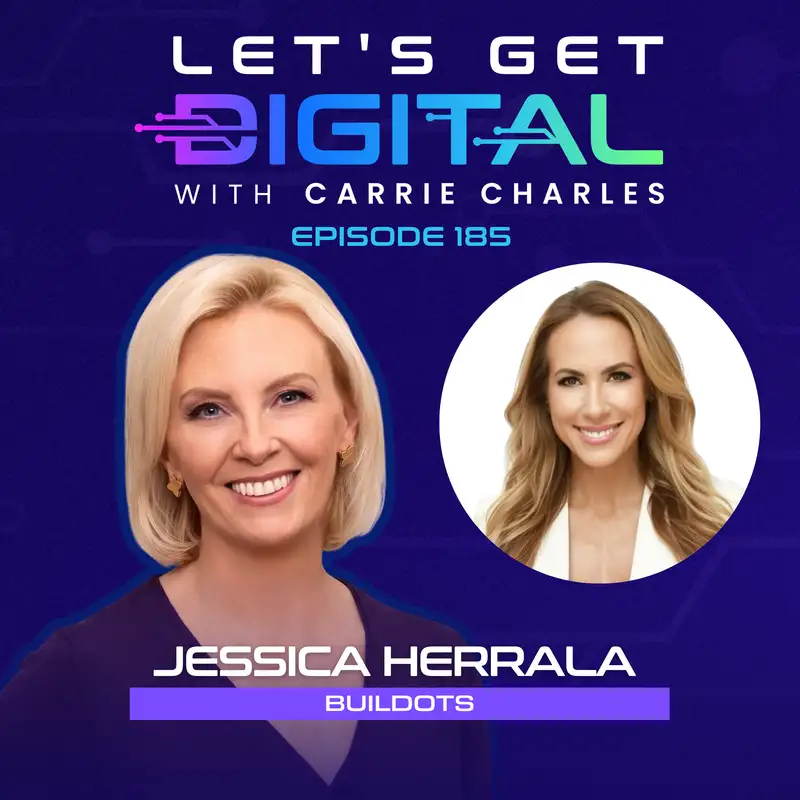
Welcome to Let's Get Digital.
I'm Carrie Charles, your host, and I'm glad you're here.
And today I have a wonderful guest with me.
We're gonna have a lot of fun, so you want to make sure that you stay tuned.
It's Jessica Harala.
She is the vice president of North America for Build Dots.
And you are gonna really enjoy some of the things that we have to talk about today.
So again, stay with us.
Jessica, great to have you here.
Finally, so glad we can do this.
I'm so glad you invited me and I'm really excited to have this chat today.
Yes, me too.
I I I know a lot about Bill Dots.
In fact, through um Mona she introduced us and got us connected and I said, Okay, I we've
got to get you on the show.
We need to learn more, not only about the company, but about you.
So let's start with you, Jessica.
How I mean you've been you've done so much.
I've been I've been researching a little bit more about you and just everything that you
have done in your professional career.
But tell us about your journey and how you got here today.
I know it's crazy.
My favorite thing to do.
I travel a lot, so my favorite thing to do on planes is everybody always asks me what I
do.
And I'm like, I'm in construction.
And people immediately giggle and go, Oh yeah, right.
And I'm like, No, no, really.
I'm in construction.
And so it is.
I mean it's a crazy background and how I got here was really how a lot of people in
construction get into this business, which is a family.
And so my dad and my uncle both worked for ginormous construction companies as I was
growing up.
And as I was looking to go to work, I worked actually for both of those companies at the
same time during college.
I don't think they either realized I was on both of their payrolls.
They were huge competitors.
But it really got me going into it.
And everybody in construction will tell you that once you're in, you're hooked.
And so I have done everything in construction other than um build or pay bills, neither of
which you want me to do.
And so it's been awesome.
This industry is just the coolest thing ever.
And it's addicting and it is a wild ride everywhere you go.
And that's how I got into it.
And now 30 years later, here we are.
Wow, thirty years of that's you just you you don't even look like you could have been
doing anything for thirty years.
So you gotta tell me your secrets later.
I got it.
I got it.
Um well build dots.
Let's talk about build dots.
w talk about the company, just everything about the platform.
It's fantastic and I'm excited to feature it.
So it's really interesting.
I had worked at three of the largest construction companies in the country up until around
twenty eighteen when I left Claiko and I was really pretty burnt out on the whole
Big construction company scene.
I was the only woman there for several years, several all companies on the leadership
team.
And I wanted to do something different.
And so this all goes back to startup life.
All right.
So I did my first startup, which was a friend who was doing a women's leadership
development company.
And I did that.
It was an amazing passion project for two years.
I really missed construction, but I just did not want to go back into big construction
work.
And so I was actually recruited into this construction technology company, which ended up
being a competitor of Build Dots.
This is early on days, right?
So we're talking about six plus years ago when AI in construction was an absolute
mind-blowing idea.
You know, I would say AI in construction to people, and they looked at me like I had eight
heads.
And
It is it was really fascinating because even me being in the industry as long as I had, I
really didn't know that this kind of technology even existed, nor did anybody for the
record.
And so when I heard about it, I immediately said to the recruiters talking to me and these
and this owner, like, this is gonna remove the gray zone from this whole show.
But the gray zone is where everybody makes money in this business.
And the reason for that is we all work on these crazy low margins, right?
And so the way that everybody's making money actually in this business is because they're
forward-building.
They are, you know, doing extra little fees here and there and there.
And so it's all this mystery.
And s bringing in something like AI and looking at the data instead of what everybody's
just talking about all the time.
Changes the whole culture of the whole thing.
Well, me at the time, I was like, well, I was done with the whole big construction thing
for many reasons.
And so I was like, Yep, let's blow this shit up.
And so I went into my first construction technology position.
It was a perfect fit for me because it brought in my construction expertise and my sales
expertise, and being in the industry as long as I had been.
My reach went very, very far through the whole industry.
There was very few people I could reach out to who didn't know who I was, to be honest.
I've changed names a few times though, so I keep having to like remind people of the old
names.
But uh anyhow, and so that company unfortunately went under, which was a really
interesting experience for me.
But it started to also show me that.
This startup life and this technology life is so much more fast moving than big
construction.
And it was eye-opening for me, but I was hooked.
And so I had really been seeing build dots, and they were trying to make a go of it here
in North America.
And I would see their teams around.
I knew they were very well funded.
I knew they had a really good product.
And I was poorly funded, had terrible leadership at my current company, but I had built a
great sales team.
I was winning work against Bill Dots.
And so I was like, I reached out to Roy, Bill Dots the CEO, and I said, you know, this is
it doesn't add up.
And so we probably, if you want to make a go of this, we need to, you need to switch this
whole thing up.
So yeah, that was a little over three and a half years ago.
And I am obsessed.
I'm obsessed with this industry.
I'm obsessed with this company.
I'm obsessed with our leadership.
I've just never been happier ever.
And the transformation that I have seen the industry make in these six years has been
nothing short of a miracle, truly, of how they absorb AI.
Yes, I can't wait to talk about that because uh it's probably an industry that's been uh
greatly affected by AI.
Um, but first tell me about the platform.
So I'm a construction actually let's use a data center for as an example because you
really play big in the data center and the digital infrastructure space, right?
So so I'm a data center, um
Oper let's say builder, let's start there, right?
Builder operator.
And so what did your platform do for me?
So, what it's doing at the heart of it is tracking progress of the project as it gets
built.
Okay.
And this is why it matters.
And it's using AI to do that.
So it takes the 3D model of the building, it adds in the schedule, making it a 4D model
where that gets built inside our system.
And then what we're using is photogrammetry once a week, twice a week, three times a week,
whatever it is.
And that can be 360 imagery, it can be drones, it can be um LIDAR, whatever it is.
And what the AI is doing is them measuring planned versus actual.
Planned being the 4D, what should be there and when, actuals with the photogrammetry being
what is there and when.
And then what it's doing is taking all of this data and it's literally tracking every
single activity that goes into that building.
And today, how construction works is it's all a telephone game.
Let's put it that way.
Cause what we do with our information is we take this data and then we start producing, we
start creating production rates.
With those production rates, we then start forecasting delays.
So regular construction, how it works today, and why construction is so messed up, is
because it goes, it's the worst telephone game ever.
It goes from the foreman out on site.
Who is let's say laying brick to be easy.
No brick and data centers, it doesn't matter.
So laying brick and the foreman is like, Yep, I'm falling behind.
Like, I'm gonna be late.
No chance I get this done on time.
And he goes and tells his boss.
And that boss is like, you'll be fine, you're gonna catch up.
And then that boss goes tells the next boss.
And by the time that message gets up to the head of the construction project, they're off
they're ahead of schedule.
Right?
So there is a huge disconnect because nobody knows the data.
We're all just believing everything that everybody says.
So imagine you're the contractor and you get this level of just gray, you know, of
misinformation.
Now take that to the owner level.
So now you're the developer of that data center.
You have to deliver that on time because
The CapEx fade that exists in your life by getting those data centers up and running one
day, one week, one month late means that your competitor down the street got theirs up and
running, and all of a sudden their lease goes and they're generating dollars, right?
As long as that project's under construction, there's no money coming in.
So as much as they complain and they have liquidated damages, which is basically like fees
onto the construction companies if they're late.
They can pound that hammer all day long.
Doesn't matter.
They're still not generating money.
So imagine the contractor needs the data, the owner needs the data to have visibility into
what's actually happening.
And with that, with AI, what we're doing is really showing all of the data, and it is
absolutely objective data that nobody can argue with because there's pictures to back
every single thing up.
And so now instead of having these conversations where it's like, you look like you're
late.
no, no, no, no, we'll be fine.
And then all of a sudden at the last minute, it's late.
Or you end up on time, but you've spent 10, 20, 30 million dollars extra trying to get it
done on time by throwing money at it, throwing more people at it.
The trick about this now is that there are no more people.
There are no extra people to throw on anything anymore.
And we are literally asking the industry to build the society, is asking the industry to
build things that we don't have the people to do.
So how do we reconcile that?
Because it's no more fun and games where it's like, just bring three more crews in.
Those crews aren't there.
So how are you ensuring that everybody's staying on time?
And the only way you can do that is to stay ahead of it with objective data that everybody
knows right when they need it.
So what makes build dots different, the platform different than let's say other
construction platforms that are out there?
Yeah, it's interesting.
I mean, this AI progress tracking kind of thing that we're doing is there's only a couple
of us.
There's actually only like three of us that do it.
So it's a really small space.
And there's a couple that say they do it, but they don't.
So it's actually a really small playing field.
What I would tell you is what build dots does differently is a couple of things.
One, we are all contractors.
We are all former contractors, especially here in North America.
You don't get hired at build dots unless you come from construction.
Big thing.
We are talking to ourselves, essentially.
So, like when we show up on site, we're not a we're not a tech person coming in and being
like, let's go look at this.
We're like, okay, get it.
Let's fix it.
Let's use data to fix it, right?
Um, and the second thing is connected to that, which is we are really hands-on.
Like,
We call it White Glove Service, which is kind of marketing jargony, but it's actually
true.
On these big data center projects that we're on, we actually have people embedded full
time on the project.
Yeah.
That end up essentially being project managers of build dots.
And so they literally sit in meetings and listen because they know what the hell they're
talking about and they hear the problems, and they can sit there and say, I I I've got the
data to solve that.
That problem.
And then we're teaching people how to fish, right?
So then they know how to do it because this is a new concept.
It's a new concept of trusting the data and not, you know, just listening to our gut
instinct.
It's a culture change, truly.
So that's the that's the second thing about it.
And then the third thing is also related to the construction thing, which is we're really
listening to our customers, right?
We are well funded, we are very heavily resourced.
And
We can shift at a very quick notice of what our customers need.
So, for example, one of the big things right now is we recognized it's not just a
construction thing anymore.
It's the owners.
These owner, these divid data center developers and owners and hyperscalers have these
same projects around the globe.
And so how are they able to see from a portfolio perspective everything going on on every
single project around the world?
And so we've developed a portfolio view that shows them exactly the percentage complete to
target that every single project their portfolio is, and then we start benchmarking all of
those things.
So the next time they build that exact same data center somewhere else, we can say, this
was the best performance on this activity, this was the worst performance, this is where
this contractor performed, this is where this trade performed.
And you really start being able to optimize everything.
But again, what we're doing is talking about data.
Yeah.
So what are you seeing on some of these construct data center construction?
We'll just stay with that.
Uh data center construction projects now that you let's say didn't see two or three years
ago.
How is it transformed?
my God.
I mean, the difference in two or three.
I we didn't even know it was coming two or three years ago.
But these things are massive.
These are projects unlike anybody has ever seen before.
And there's definitely the, you know, Bechtels of the world and the Halliburtons of the
world that have done these huge, you know, ginormous projects and power and energy and all
this stuff.
But these data centers are being asked, they're actually not that complicated.
They're not complicated to build.
They're actually very simple to build.
But the problem is they are being asked to build them in such quick time.
And they're so large that it's it's these companies have never done anything like it
before.
And I walked onto a site the other day in Abilene, Texas.
It's a $25 billion data center.
And I'm like, oh my God.
I mean, I
The operation of it is just massive.
They have 10,000 people a day onto these projects.
I mean, think about the logistics of getting 10,000 people onto a project site every day.
They are billing like, you know, millions of dollars a month.
I mean, it's just it's astronomical.
And so I think that's the huge thing that it is really testing the industry.
We didn't have enough people.
Two or three years ago.
Now we really don't.
You're seeing shifts happening all over the place in the industry on the owner side and
the contractor side.
People are just jumping.
They're jumping every six months because there's so much money out there.
So the people resourcing is the biggest thing that I'm seeing.
The um stretch to the capacity of companies is happening.
Um
And it's it there's really a lot of risk that's being put out there.
Right.
W how has AI really can changed the construction industry just over the years since you've
seen it?
And I Bill Dots has been a part of that.
Yeah.
Well, I I think the social aspects of AI really played a part in that to make everybody
more comfortable.
So I really give a lot of credit to, you know, the chat GPTs of the world and then Gemini
and then Claude that slowly and then very quickly people started using it in their daily
lives.
And then it started to make them feel more comfortable to do it uh at work, using data,
you know, at work.
So now you're starting to see
some of the old you know some of the more crotchety kind of people be like, yeah, okay,
now I could use this.
And it's actually because they know they can't do their jobs.
They can't.
There's not enough people.
So they gotta start, they can't spend four hours a day walking around a job site anymore.
And that's for the contractor or the owner.
And they have to be able to utilize their time more efficiently.
And I always say to people, AI is not meant to replace
You putting your boots on and walking out on site.
It is meant to allow you to have time to spend on the things that matter.
Spend that time on safety.
Spend that time on quality.
Spend that time on devising a plan on how you can do the next phase better and do more
with less people.
And that's the progress that I have seen happen with AI in the industry.
And I give a lot of props to IT departments in these huge construction companies who never
thought in a million years that they would be dealing with AI.
They were like, you know, the computer fixers.
And now we're asking them to do these crazy security reviews.
And yeah, and so I give a lot of credit for these old school construction companies who
have been able to adapt.
So Jessica, I forgot to ask you, what are all the verticals that where build dots plays?
Yeah.
Build Us plays in anything vertical.
So the only thing we don't do today, and that doesn't mean we wouldn't be doing it in
three months or six months, is roads and bridges.
Um, anything that's horizontal.
I wanna continue to talk about people because I mean, this is a space we play in every
day.
It keeps leaders, it keeps everyone up at night.
How are we going to
staff, these projects, you know, how are we gonna do this?
And I just want to hear from you.
Let's say in the last twelve months, what have been some of the most challenging people
problems and talent problems that you've had and how have you been able to solve them?
Hmm.
I would say you mean at Bill Dots, hiring at Bill Dots.
Is that what you mean?
Yeah.
dots or maybe maybe you can even just use some of your experience, you know, just recently
that you've had.
yeah, just because I think it's gotten a lot worse just literally in the last twenty four
months, really in the last twelve six to twelve months even.
It's so difficult.
You know, I just did a LinkedIn post the other day because all I hear about is people,
yeah, people are like, the job market's so hard, there's no jobs.
And I was like, Jesus, I just I can't hire enough people.
But it really is that I'm looking for very specific people, which I don't think is any
different from anywhere else.
Um, my biggest challenge has definitely been that I'm looking for a lot of unicorns.
I'm not looking for one unicorn, I'm looking for a lot of unicorns.
And it takes a special person because you have to be a construction, you know, you have to
have a background to come work here.
And so it's a lot easier for me to recruit now than it was three years ago when I was
asking people to kind of jump into the deep end of the ocean with me with no floaties.
Now you know we're established, it's actually a lot easier for me to recruit.
I have more resumes in my inbox than I can hire, but they have to be qualified.
I would say on the construction side though, you know, what's really changed is there's
just not like I said, there's not enough people for them to hire.
And I can't every time I go and have these conversations with these, especially these data
center builders, and I'll use one in Texas and again, a different contractor in Texas.
So I was there a few months ago.
And he's like, Jessica, my superintendents do this.
I don't need this.
I don't need anybody to do this tracking thing.
Like that's my superintendent's job.
I'm like, that's cool.
Uh, get that.
But how much do you trust these superintendents?
And he's like, I trust them with my life.
And I was like, How many of those superintendents might have been Uber drivers?
Like, I don't know, three days ago.
And he's like, hmm.
And I'm like, and let me ask you something.
How many of the superintendents are you now asking to do three projects instead of one
project?
And he's like, um,
And I said, right.
So how sure are you that if somebody came along and said, I'll pay you double, that they
wouldn't leave and go somewhere else?
And he's like, uh and I'm like, and where does all that institutional knowledge go?
And what's the cost for you when those people leave to replace them with people who might
have been Uber drivers three days ago?
And he's like, uh.
Okay, I I got it.
And like that's where we are.
I mean, truly.
Like, we've got laborers showing up on project sites who like my good friend Greg Dunkel,
who's the CEO of of Structure Tone, was telling or S T O B G was telling me this the other
day.
He was like, Yeah, I ran, I was walking a job site, I ran into a guy who was like looking
kind of lost.
He had his tool belt, it was clearly very new.
And so Greg's like, I just stopped and asked.
Like, you know where you're going?
Not really.
Well what trade do you work for?
I think this one.
Well, what are you working on today?
I I don't know.
Well, okay.
What's your specialty?
I think plumbing.
Oh no.
Oh no.
like, well, what's your background?
And he's like, I said something.
And he's like, Have you ever done plumbing before?
No.
And this was on a data center project.
Okay.
And so this is this is the challenge that we are facing right now and why it's so
important to have absolutely objective data in your toolbox because you just have no
freaking clue what's going on in these projects every day.
So you have built commercial teams all across North America over your career.
And again, our space, as we've talked about today, it's exploding.
uh People, when you can when we can find people, we're building teams.
What are some of your trade secrets on building high-performing teams?
It's funny.
I just was coaching a leader uh internally yesterday.
My okay, here's my here's my things.
My first one is to lead with absolute, genuine care.
It's not even about empathy.
And it's not even about care.
That's not the right word.
What I want to lead with is
just really being yourself.
I I put myself out there.
I don't have airs about me.
I don't I just put myself out there.
I am a genuinely a normal human.
And that is the biggest thing because I interview, believe it or not, in person, every
single person that gets hired at Build Dodds North America.
They fly to me, I fly to them.
It doesn't matter what reporting structure they have, they have a meal
with me.
And it's scary for them.
Not for me, but it terrifies them.
But I'm I disarm I'm I disarm them very quickly by just being a normal person.
Empathy, huge.
Like women are great leaders because we are more empathetic leaders than men.
I hate to say it.
Love you men, but we just make better leaders.
And it's because we do care, we do listen.
And
I truly believe every work conversation should not start with work.
Work conversations should start with what's up, how's your day, what's going on with the
dog?
I remember every person's child's name, I remember every dog's name, every cat's name.
It's it makes people feel important.
And they are important.
And so having that level of authenticity and empathy.
And capability.
They people have to know that you're a genuine, capable person and the company is stable.
So that's been my trick.
And I think that that's a solid trick for every company and every leader.
Start with that.
Yeah.
so important.
Um, yeah, we could have an entire show, probably an entire six months of talking about
authenticity as a leader.
So I love that you said that.
So let's talk a little bit more about developing women in leadership because I know that's
something that you're passionate about.
And so number one, we need more women.
in construction.
We need more women in telecom and data centers and digital infrastructure and technology.
Like, you know, those are the fields where we don't have enough.
And, you know, you've been in this industry a long time.
You've been, you know, probably the only woman in the room many times.
So I guess my first question is gonna be around how do we really attract more women?
But then once we attract more women into these industries, how do we keep them?
How do we develop them?
So let's first start by do you know any
strategies that work to really, you know, where do we find the right pools or how do we
attract women into the industry?
It's I it's a hot topic for me because as I reflect on my hiring here, even because when I
started hiring, I was just hiring sales teams.
And uh all I was hiring was men.
No matter how hard I tried to hire women, I could not.
My entire sales team, minus like a couple now, are all men.
And I had to reflect on it.
Now I'm hiring women, which is great.
But um
Women just are risk-adverse humans.
We are.
By nature, we are risk adverse.
And for startup environments or for data center environments that are going to be very
rigorous, it is asking a lot of women because no matter how hard we try to balance out
roles and responsibilities at home, women are always going to take on more.
So to say to them, it's a startup environment, we work very, very hard, we travel a lot,
we have very high expectations, you're you know, you're working some on commission, like
it's scary for women.
And men have a better confidence level about stepping into something like that because
their egos are so big and they just believe they can do anything.
And women
When I coach women, I do a lot of what are you scared of?
What's the worst thing that could happen?
And really get into a lot of that.
And I even do it in the interview processes because I can tell that they're fearful.
What's the worst thing that can happen?
And I'm very clear to say, this is a crazy job market.
You are very talented.
If I want you, everybody else wants you too.
So if this doesn't work out, what's to say you can't go get another job in two days?
Well, but but I'm like, no, there's no but.
There's no but.
If I want you, other people want you too.
And so I have always told I this is for the last 20 years, maybe every time somebody asks
me what my secret is of oh to for women, I've never feared getting fired.
Ever.
Because I know I'm marketable and I know I can get another job tomorrow.
And women need to have more of that confidence level in themselves.
And it's not a quick fix or an easy process.
But that's the key.
So no, I I couldn't agree with you more.
I think uh I think fear, fear stops us so, you know, so much in so many ways.
So I definitely agree with you there.
When we're talking about developing leaders, because you're also really good at developing
leaders, but then also developing female leaders.
So how is that different, by the way?
Like developing
A woman into a leadership role versus a man.
Is that d do you do do you have different strategies there?
I don't know that I have different strategies.
I would like to say that maybe sometimes I'm softer with women, but I'm not.
I might be harder.
I might be harder on developing the female leaders than I am the men.
Because uh
The women need to hear it sometimes.
I think so many men actually don't develop female leaders well enough because they're
scared to hurt their feelings.
And I am not scared to hurt their feelings because where I have succeeded most in my life
is when my feelings got hurt.
Because it made me stronger.
And it made me be like, you know what?
Screw you.
I'm gonna prove you wrong.
Mm-hmm.
And I want to instill that in other women.
And so they need to get that.
They need to get that gumption behind them.
And and men should not fear hurting women's feelings.
They should be just as hard, if not harder, on women than they are on the men.
Uh and that's been my motto.
I mean, you really made me think about that, but but yeah, that's I think if anything,
I've hurt more men's feelings than I have women.
In my career, truly.
What about a tip for a woman who's in, you know, the let's say one of these male dominated
industries, construct we're talking about digital infrastructure right now, construction.
Um, how how do how does that woman succeed and get to those top executive levels?
Do you have a couple of tips that you can share?
This is such a i this is a very controversial thing that I have.
So my biggest thing is um is calculated interruptions.
So there's so many women sit around and wait for their turn to speak, and I don't.
And that has sometimes gotten me labeled a, you know, uh a well.
My favorite label is lovable bitch because like I might interrupt and people might be
like, she's such a bitch, but like what comes out of my mouth actually is like makes
sense.
And um yeah, calculated interruptions is a big thing for me that I teach women all the
time.
Like, why are you sitting around waiting for an open opportunity to talk?
Why aren't you just talking?
And if what you say is something important, nobody cares that you interrupted.
That's my honestly one of my biggest tips.
But it is controversial because business people will tell you, you know.
It's a good one.
yeah, and then my second one is stop saying no.
Stop saying but stop saying I can but or if or just say yes.
Just say yes and do it.
Those are my two biggest tips.
Oh shoot.
I think my internet went out.
I'm sorry.
could
did your internet go?
Wait, hold on a second.
Are you did I lose you?
yeah, I can hear you.
You just got you got quiet for just a second.
Hold on.
We can we can stop it, just say yes, and then we can start.
Then we start again.
perfect.
You're back.
So what we'll do, we're gonna stop it, just say where you said just say yes.
Did you say anything after that?
Mm mm.
No.
Okay.
So we're gonna cut at just say yes and then we're gonna pick up uh right now.
So Jessica.
wait, you don't have to say that again.
So we're good.
Yeah, no, we'll stop.
We're we rather just say yes, and then I'm gonna go ahead and I'll I'll come in and I'm
gonna ask you how to learn more about build dot.
This is awesome, by the way.
This is so so good.
This is so so good.
so
Start now.
So Jessica, I love this conversation.
And you know what I love about it is that you're so real and you're so straight and you're
saying things that we're all thinking.
And you know, it's even helped me because I'm thinking to myself, how many times do I wait
to talk?
You know, and and I'm being the good girl, just sitting there waiting for my turn, right?
So I wanna thank you for being real.
And and just this has been a fantastic interview.
I've loved learning more about you, about build dots.
And I just want to meet you someday in person, but you're traveling all the time.
You're constantly in the air.
Let's go, let's go.
Um, how can we learn more about build dots?
So please reach out to me on LinkedIn.
I am a big LinkedIner.
Um, and so you can reach find me at Jessica Harala.
And uh builddots.com, B-U-I-L-D-O-T-S dot com.
You can reach us through there.
All my contact information though is on LinkedIn.
So please feel free to reach out anytime.
Would love to connect.
Fantastic.
Thanks so much for coming on the show.
This is this has really been one of my favorites.
Thank you.
Carrie, thanks so much for having me, really appreciate it.
All right.
We'll stop there.
That's awesome.
This is great.
I just love your style.
I love it.
I love it.
Stop.