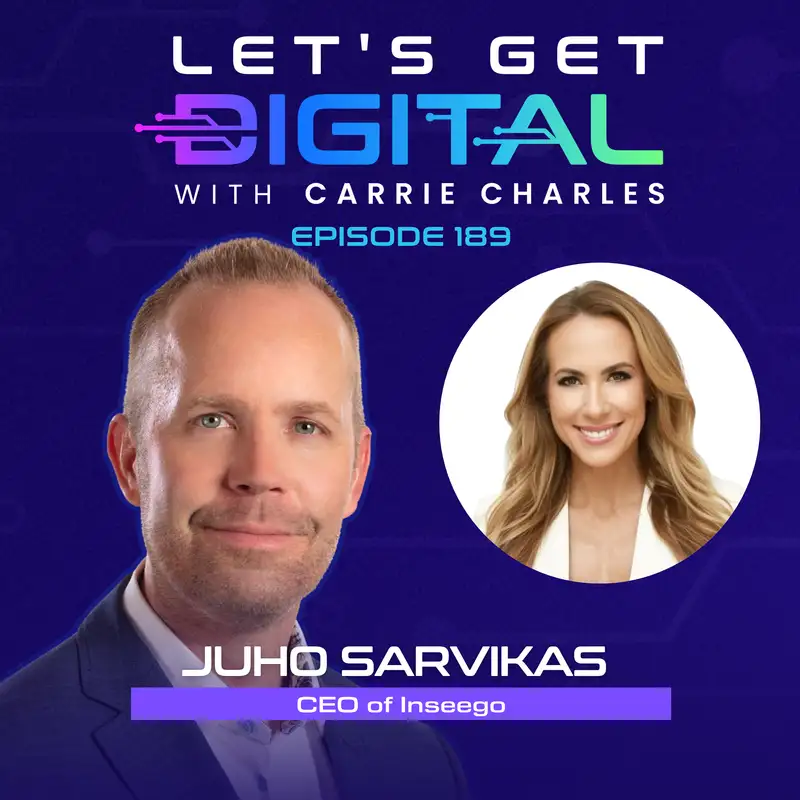
Thank you for joining me today on Let's Get Digital.
I am so excited that you're here.
You are gonna love this episode.
I have with me today Yuho Sarvikas.
He is the CEO of Incigo.
Now.
And Seago just bought Nokia's fixed wireless business, and Yuho is here to tell us why he
thinks the industry still underestimates what wireless broadband can do.
Yuho, thank you for joining me.
I really can't wait for this conversation.
I think it's just gonna be just gonna be so engaging.
Thank you for having me, Carrie.
It's an exciting time at Insego and I think overall for the whole industry.
So what a great time to have this conversation.
So first, you have led Qualcomm North America.
You were found a founding member of HMD Global.
Now you're the CEO of Incigo.
So tell me, you know, tell me a little bit about your journey and what brought you here.
Happy to share.
I had a uh I was very fortunate.
I have a li life-changing experience right out of university.
So my first job was what I thought would be my dream job decades in the future.
But I landed a role as a product manager at Nokia.
This was 2006.
And if you remember, the coolest thing that you could think about was a smartphone.
That was the time when there was a lot of innovation in the category, technology was
advancing really fast.
And back in the day, in that role, what I was able to do was essentially run my own
company inside Nokia.
And I found that to be absolutely fascinating.
I also uh
Observed some of senior leaders that I really, really came to uh appreciate and admire
having a cross-functional experience.
And I it might also be an issue of my attention span or my nature.
I'm very anxious.
I'm very keen to move forward.
I'm very keen to learn.
And what I decided to do was to see how much cross functional experience I can gain, how
holistic view I could have of the industry.
And that really set me on an international journey.
We spent a lot of time with with the family in Asia and we moved to US with Nokia in uh
2009, I believe.
And really everything that has
uh That initial inspiration led me to build a career where I got to see different parts of
the value chain.
I've been a CMO of a company, I really feel at home as a product.
But really the holistic PL experience, um the ability to build winning teams is
something that led me here.
So tell me about Incygo.
I want to know all about it.
I um learned about Insigo when I was the president for Quacom North America.
They were um were actually right next to Quacom here.
Insigo was one of my customers and I also had a very strong vantage point in terms of
what's happening in the wireless broadband and in the carrier ecosystem overall.
Having spent a lot of time um
Ever since beginning of 2020, when FWA really started to emerge at scale.
In Cugo has a long history of technology and innovation leadership.
The company has been around for two decades.
Whether it's the invention of mobile hotspot or MIFI as it's become to known, we actually
own the brand for MIFI, um, which is synonymous for mobile broadband.
The company is was also the first to uh commercialize FWA when it comes to millimeter
wave.
So you have this company with very strong um
Technology leadership legacy in a market that's rapidly expanding.
So, really, what we've been uh what we've been all about for the past 18 or almost two
years that I've been here is rapidly expanding in the marketplace.
And I'm super proud of the great work that the team has done here in the US with the large
three operators, where we're the preferred partner not only for mobile hotspot, but also
when it comes to enterprise FWA.
And now, of course, with the acquisition of the Nokia FWA.
Business where uh over doubling the size of the company, we're going international.
Um, yeah, very exciting times for us.
So let's talk about the Nokia uh fixed wireless access acquisition.
So FWA, that's how we'll state it from this point forward.
The industry has been talking about this since it was first announced.
So now that it's closed, what actually changes for Incigo?
It's a completely new company, if you will.
So yesterday or
Still still a couple of days ago.
We were uh focused on US.
We had the three large customers here, we're more in the enterprise space.
Now with the Nokia FWA acquisition, APAC, um Europe, Middle East, Africa become very
important markets for us.
50% of the company's revenue, or over 50% of the company's revenue, will now originate
from the global markets.
It also gives us a broader portfolio and the ability to do an excellent job for
residential customers in addition to the enterprise and
Market where we already have excellent solutions.
So now the objective here is to bring the business that we acquired, which is again more
in the residential space, into the US market, and at the same time bringing our enterprise
solutions and our mobile broadband solutions to the global markets.
And of course, at the same time, we're uh we're welcoming a lot of new employees into into
Insigo, an amazing engineering team, supply chain team, uh, and we've hired
a new sales and marketing team globally.
I'm actually super proud of how we've been able to essentially uh make this carve out
where you did not get a completely operational business.
You had to complement, you had to go and build new, uh find new amazing talent.
We've been able to pull all of that together and business is up and running and there's a
lot of exciting expansion opportunities as I look and look in the future.
So Nokia stays on as a partner, right?
Yeah, Nokia owns now eleven percent of Insigo.
So there's actually a backstory there that I would love to share with you.
So so
do, please do.
initially when I um when Justin Hotar started as the CEO, right around the same time as I
did, he's been extremely successful in pivoting the company to data center infrastructure
and really focusing on this AI super cycle, as he calls his strategy.
So after a strategic review, uh he concluded that the edge
namely the CPE or the FWA part of the business, is something where he can partner.
He does not need to do that in house.
He can focus on the infrastructure side.
So we engage early on in a strategic discussion
to uh understand what Nokia was looking for with the transaction, uh explained how um this
is super complementary for what we do at Incego and why we are the right home for the
business.
And one of the key things really was to make sure that the customer base, the
international carriers who are also very important for Nokia on the mobile network side,
that they get the best possible experience going forward.
So in the end we ended up doing an equity-based um
transaction where Nokia is now an eleven percent shareholder of InSigo and I'm uh super
proud of that.
I think it's it's really important for me and the team.
I think the culture in what Nokia stands for, what InSigo stands for, um very good
alignment.
So where do you expect the two companies to work together, um, especially with AI and even
six G?
both of those areas and actually they're uh inherently paired together.
If you look at six G
What's really going to be transformational is uh of course you'll get 10x the speed of 5G.
By the way, if you think about FWA growth that was really driven by 5G, now it's getting
10 times better again from a performance standpoint of view.
There's going to be a lot in terms of spectrum efficiency.
So the operators will be able to deploy more FWA with the same network resource.
And now, of course, Nokia is an in the networks, right?
So our partnership together with Nokia is one where as 6G
Matures and becomes commercially available towards the end of this decade.
You will see us in early trials, you'll see us collaborating with Nokia on how we can be
better together between the network and the edge.
And uh pervasive AI is another key enabler.
Actually, it's a foundational.
driver behind the 6G standard.
Now the CPE or the Edge will become an integrated part of the whole infrastructure.
And between the compute that you'll have at the edge and at the network edge and of course
at the core is something where from an end-to-end integration standpoint of view there's a
lot that we can drive together.
So I'm I'm very excited about the technology partnership that we've also established with
Nokia as a part of the transaction.
So Insigo has been mostly a US company, as you said earlier.
Um, how does that global footprint change the way that you're gonna think about customers
and product and enterprise and everything?
It's been uh mind blowing as a part of the due diligence and now of course with the
transaction coming to a close to go travel the world and meet all of our new customers,
whether it's Japan, Indonesia, India, or Italy, there's a lot of similarities across the
markets.
First, fiber penetration has gone through the roof.
Like in Japan, virtually every household is connected with uh fiber.
Yet FWA is very resilient.
There's multiple use cases, whether it's mobility, affordability, ease of deployment, why
FWA or broadband continues to uh defend market share but also grow.
And now as you look into 6G, what you'll what you'll discover is that that trend, I think,
will only be accelerated.
So for me, what's absolutely vital is that we've now acquired this global footprint where
in all of the key markets, we have the sales and marketing team to be there, we have uh we
have the scale and supply chain in engineering to cater for all of these markets.
So how do we continue to build on that stronghold?
And as the acceleration happens towards the end of the decade, we want to be the preferred
partner.
So what do you s what do you think that the industry still uh underestimates about fixed
wireless?
You you broke there, I think there was an issue with the live stream.
Do you mind asking the question again?
Okay, so stop here and then we are going to start again right now.
So what do you think the industry still underestimates about fixed wireless?
I think it's only the dawn of fixed wireless access.
If you look at 5G, the real only new monetization for the carriers was FWA.
And that's not a US lens, that's happening globally.
Some markets, some operators were more aggressive early on to the market.
Others wanted to see how it develops to be able to protect their higher RPU mobile user
base.
Because you don't want to get to a situation where you're compromising your, let's call it
core business as such as a carrier.
But now
The market has gotten significantly more sophisticated.
It's very measured in terms of where where can you deploy without compromising your
network performance and at the same time be able to extract more ARBU.
So that trend will continue.
I think there's more and more awareness in terms of how huge of a value unlock this is for
the carriers.
And like I mentioned, markets like Japan, markets like here in the US, you're seeing more
and more deployment.
At the same time, there's also value-added segments which are largely unlocked globally.
We've done a great job here in the US with all of the three large carriers in building an
enterprise or B2B fixed wireless access franchise.
You have the in Sigo Cloud, you have our world-class hardware, and you have everything
that an enterprise IT manager needs for the deployment.
And that has really enabled the carriers to address this value-added segment where uh
You get of course enterprises the holy grail from a margin standpoint of view for the
carriers.
It's also a segment where we thrive.
And now enabling that globally or even accelerating here in US is something that uh I
believe is going to be a huge growth driver and a huge profitability driver for the
carriers.
So where do you see the growth with fixed wireless access right now?
It's interesting, it's uh very polarized if you will.
If you go to a market like Indonesia or India, there's really no other means of connecting
the end user.
There's no broadband, homes are homes are not connected.
So in those markets it's a matter of uh closing the digital divide, um empowering the
society as a whole to connect and
With everything that's going on in AI, how how the uh economy is transforming, that is of
course extremely powerful and very important.
Those deployments are large scale, very different dynamic.
At the same time, if you look at markets like US
You can use 5G, FWA as a failover solution in case you have an issue with your fiber, or
it or it's becoming more and more the primary means of connectivity.
So depending on the market, you can look at everything from a value-added deployment at an
enterprise to uh just bare minimum means of getting people connected and driving
economical growth for the society.
So operators have limited spectrum assets.
What technologies are out there to really sustain the FWA growth?
One of the key
Values of in Se Go is technology leadership.
And if you're if you're a customer, what you will get with us is the latest when it comes
to 5G technology, which is very helpful, not only in terms of performance, but also
network efficiency.
So you can deploy more with the same resource.
At the same time, if you look at sub 6 gigahertz, it's globally speaking constrained.
Spectrum policies have been different between various nations.
US is fairly fragmented in that, but you can see.
Auctions more and more spectrum availability.
However, there are key technologies that will uh enable carriers to unlock capacity beyond
the traditional sub-six uh spectrum.
Millimeter wave is one of those where you have deployments here in the US, but also
globally.
Actually, some of our new customers in the global arena, be that in Australia or Italy,
are deploying FWA exclusively on millimeter wave.
Millimeter wave, of course, requires uh line of sight.
It's a fairly complex deployment.
One of the really uh cool technology assets that we inherit or gain as a part of the
acquisition is
Antenna technologies as well as install technologies where you can have the end user
themselves deploy millimeter wave and in a very easy way make sure that the line of sight
is there, avoiding a truck roll.
So that's one area.
There's also a licensed band radio, which would be a non-3GPP.
implementation of millimeter wave and there's a lot of millimeter wave spectrum overall
globally that has been awarded or auctioned out to the market, but it has not been
deployed because of the complexity.
So that's an area where we think we can help a lot as well.
So what about satellite?
Where does satellite fit in with FWA?
Um, is it a competitor?
Is it a complement?
You have no idea how often I get asked this question, or maybe you do, and you're likely
asking it for the same reason.
So uh satellite, is it an existential threat for FWA?
How should we think about that?
I've seen it be complementary.
So if you look at FWA, I think the misconception is that FWA is only deployed in remote
areas where there's no other means of connectivity.
And of course, if you're out in the countryside, satellite.
Is a great solution for you.
So you might think that FWA is getting compromised or losing share because of satellite.
We're seeing a lot of demand for satellite failover for FWA.
So if you look at it from an economic standpoint of view, ease of deployment.
Standpoint of view or overall in terms of uh best solution for the environment, um, it's
very often that an enterprise will want to ensure resiliency almost at all cost.
Having said that, satellite is banned can be bandwidth constraint and it's very expensive.
So the solution that we're working on with multiple partners is that you have a 5G FWA
primary solution, be that an outdoor solution or indoor solution, with a satellite
failover.
And that's an area where we
Made a lot of investment in terms of software capability.
um And again, this enterprise segment where we thrive as a company is the is the area
where you have most demand for that solution.
It's also good to acknowledge that FWA, if you look at our deployments or the market
overall, it's really in urban areas.
And in urban areas, satellites, just because of the density of the deployment that you
would need.
install and just like from a need standpoint of view is uh is not as pronounced as the
remote area.
So I I look at turning satellite into a competitive advantage for in Seago by ensuring
tight integration, manageability, everything that we're doing today already.
Now we're expanding to another wide area network connection.
So I was curious about that question because I'm actually, you know, the network I am on
right now is a satellite network.
And uh I'm here in Puerto Rico, which is a in a very remote area.
So it's it's fascinating.
I wouldn't have thought you know, what you just said really opened my eyes a lot.
Actually, this entire conversation has opened my eyes to fixed wireless access and a new
way of looking at it.
Yeah, it's um
Our job is to be the connectivity partner at the edge with the manageability, with
everything, and then of course the enablement that you as a carrier need to manage your
residential or enterprise um segment.
For me, satellite is just another wide area network connection.
So you can have as far as we're concerned, you can have fiber going into your in Sigo
router.
Of course you'll have 5G there.
You can plug in satellite, and we want to be the intelligence behind that connectivity.
So let's talk about six G.
What does six G mean for devices at the edge?
Um it means significant performance boost.
So with 5G, like we discussed earlier, the big new use case really was FWA broadband.
With five G finally cellular connectivity could provide connectivity performance that
dwarves cable, also in reliability, but definitely makes DSL obsolete.
Now with six G
you will get fiber-like performance.
You can get that today already with millimeter wave when it comes to FWA.
But with s with 6G the overall performance will be dramatically improved.
And then secondly, this AI orchestration end-to-end from the uh CPE all the way to the
core of the network will enable optimization, efficiency gains.
And I think you'll see a lot of innovation when it comes to where the overall compute or
where AI resides.
Today, you have these monolithic data centers.
It will be fascinating to see what happens when once 6G brings performance up.
latency further down and improves the overall performance of the network and the
availability.
So I think we will see a completely new compute paradigm that will have a transformational
effect on where AI is going next.
So you've been traveling a lot and I want to hear just a little bit more about that.
Um you uh just got back from meetings with carriers in Asia, in Europe.
What were carriers most focused on in those conversations?
First of all, they were very happy to welcome us.
We In C Ego has a strong reputation in the industry.
The company has had presence in international markets, not in recent years, but the brand
is known, it's well recognized, everybody knows us as a trusted partner for large-scale
deployments.
The the most interesting discussions I end up having is how can I help?
our newly found customers to grow and build on their FWA franchise.
A lot of that centrals around manageability, the enterprise end market, but also how we
can help scale on the residential deployments.
So I find it absolutely fascinating to take the recipe that has made us successful here in
US and localizing that to uh well markets like India on a large scale basis or or Italy or
any other country for that matter and just
So five years from now, what does wireless look like?
That's my first question.
Show me the future.
my my my working theory, which I keep telling everyone, is that the end game is wireless.
When it's all said and when it's all said and done, maybe absent data center connectivity,
there's no reason why everything wouldn't move over radio waves.
The technology is heading that way.
It's your typical innovators' dilemma where with 3G and 4G, you used uh cellular
connectivity as a fail-safe for critical operations.
But it really wasn't deployed at scale and it wasn't often the primary means of
connectivity.
Now what you can see already today is that 5G FWA is overtaking other means of
connectivity and that trend will only accelerate.
So uh the whole notion behind in Sego disacquisition, uh why I'm here, is that the TAM,
the addressable market, will effectively become infinite.
It's only a matter of time.
So in Siego now, speed up the movie for me, five years from now.
Tell me about In Siego.
I want be a uh turnkey solution.
So you're operating you're a carrier and an operator, whatever that might be in the world.
You have a mixed portfolio of fiber, obviously seller, maybe you have a satellite
partnership, and you need to build your wireless broadband business.
You're the PL owner, you have a commercial segment, you have consumer segment.
You can call us.
We're a turnkey solution.
We have a full-blown solution suite.
We will tailor make it to your um your requirements, your end market needs, we'll
collaborate with you, we'll be your most responsive partner.
And that's really how how we scale globally.
My my view is that if you're the best partner, the best company to work with and you have
the right solution technology strategy, there's no limit to where we can go.
Love it.
Youho, thank you.
This has been so educational for me.
And uh I'm just really thankful that you came on the show.
Absolute pleasure.
Thanks so much for taking the time with me.
Of course.
I hope to meet you in person soon.
Take care.
All right, don't jump.
Let's