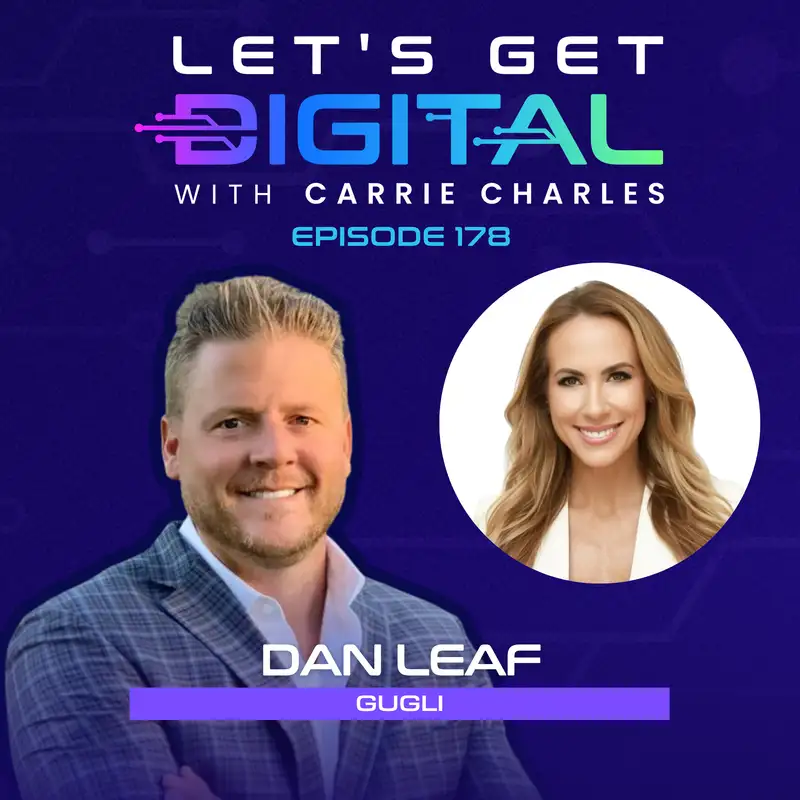
Thanks for joining me today on Let's Get Digital.
I'm Keri Charles, your host.
And I am really excited about my guest today.
I have followed his journey now for, since I've been in the industry for over 10 years.
So my guest today is Dan Leif.
He is the founder and CEO of Googly, a visionary entrepreneur building technology that is
reshaping public safety and smarter infrastructure.
Thank you, Dan.
I'm so excited for this conversation.
I am too, Kerry.
Thanks for having me and I look forward to jumping in this with you.
Let's do it, let's do it.
But first, I do want you to tell your story.
I have, like I said, I've known you for over 10 years and I, you're just such an
inspiration to me.
Everything you've accomplished and now what you're doing to really make a difference in
the world.
So fill us in, tell us about Dan's journey.
Yeah, absolutely.
And likewise, Kerry, think just watching your journey has been just as inspiring to me.
So it's been fun to kind of collaborate together.
But my professional journey has really been shaped by entrepreneurship in a space that I
think's evolved so much in the last 20 years.
Between cellular, public safety technology, it's where I landed with my career, just as
these systems are becoming available and kind of come into market.
iPhone was first.
put out by AT &T and then we can look as it evolved over the last 15, 20 years.
I started my career and my journey building out and scaling companies as an integrator in
the space, um really designing and deploying critical infrastructure systems and
communications.
And those two companies were really more transactional model.
We were able to scale quickly, had a couple of successful exits.
But what I took away from those is the phase through those.
companies is how to really execute in the field.
It's not a lot of room for error.
So over that period of time as an integrator, I started seeing bigger issues.
So we started installing critical communication systems, but there's very little
visibility whether these systems were actually working when it mattered most.
So it was very critical to have these systems tested before occupancy, but after the red
tape was cut, they were often forgot about.
And so that's what really led me to Googly, where we're at today.
And really looking at the mission, it's pretty simple for us, is helping save lives by
ensuring these first responder systems communicate during emergencies.
So instead of deploying these systems now, we're building a platform that continuously
monitors these critical systems.
Because failures in these systems just aren't a technical issue.
It's really the consequences of a liability, but more importantly, the life safety and why
these systems are deployed.
So that's really the journey that's brought me here.
And it's been a fun one as the markets evolve.
Yes, and I know you're up to really big things now with Google.
Let's go into a little bit more detail about what you're doing at Google.
I know that you're developing new technology.
mean, there's just so much happening.
So tell us more about the product and the service.
Yeah, mean, what's really sparked was through the Leaf Communications days.
We were putting these systems, like I mentioned, um and I remember thinking after we
deployed these, these don't make much sense.
After they're deployed is we're talking about systems that first responders rely on and
then essentially flying blind.
And so that's really where Google is built to solve that exact problem.
We saw a shift in the industry from a one-time installation mindset to continuous
awareness.
And it was a gap that we identified years ago.
So we created a platform that monitors these critical communication systems in real time.
So building owners, operators, first responders, anybody part or associated with those
systems actually know these systems are functioning when it matters most.
And so, you know, what makes this meaningful for me is not just the efficiency play or a
cosplay, but it's reliability in the moments that count.
You know, so firefighter walks into a building, communication has to work.
You know, there's no margin for error.
So the founding story
really came directly from being in the trenches, seeing the gaps and deciding to build
something that would actually fix this gap and use some innovation, some technology.
So we're really bringing hardware and software to this model and trying to make it more
automated to give real-time insight to these uh systems that deployed everywhere.
So there's been a mandate in New York that I know that you have been involved with and
also I think it's going to mean something for Googley.
Tell me a little bit more about that.
Yeah, so New York, we've been we've been part of that process for them looking at their
new fire code.
So about 2014 is the last time they've updated their fire code.
And that really derived from Googly's story.
know, 9-11 happened, the World Trade Towers in 93 happened.
And you can see that these systems were learned that you learned a lot about these systems
after these incidents happened.
So if you look at 2014 to now, the fire department's done a good job of seeing, OK, what
where areas are failing?
Where can we?
make our system stronger.
They don't follow the traditional NFPA 72 code.
They basically write this code for themselves in the New York market.
And so what they've done is now put together a mandate that will start to require
monitoring and that will be released soon.
January 1, 27 is when it will become an effect.
But we've put together a long program with them to be able to walk into a building and
visually and digitally see the health of these systems at the fire department level.
The way these systems are deployed is when you get on site, within a minute or five
minutes of a fire, there could be a thousand men getting on site.
So these systems have to be known.
They're working not within minutes or hours, but seconds.
so New York has been down that road of testing and deploying these systems, being able to
make sure that they're monitored correctly.
But beyond that now is what happens if something's wrong with it when an incident doesn't
happen.
So now Google is really driving the force behind how these are recognized up in the cloud
and how these are
pushed through the whether the maintenance contractor for that property in that building
or through the FDNY knock of saying hey this is a true alarm that could have some real
consequences so there's some action plans behind that and so you know we expect what New
York is doing to go across the country it's really slick um but it's been very very
powerful to watch them see the need to real-time communications see what our mission is
constantly and what our vision is and what we're driving for
and then seeing it reciprocated back in the market to where they see the value in making
sure these systems are working when they need to be.
So what is NFPA?
Is it 1225?
And yeah.
so that's 1225, the latest edition.
27 is being written and probably pretty close to being finalized.
That will be released and it'll start to be mandated in January 1 of 27.
You know, part of these systems are archaic.
They've been around for 50 years.
They've been built slowly and evolved slowly over time in real world scenarios, but not a
lot of forward thinking.
And so we're seeing a lot of language being entered into the code.
that supports what our mission is and that's making sure there's more control over these
systems.
They're automated, they can see real-time alerts.
um know, as thousands of buildings are deployed, that means thousands of systems are
deployed.
There's also an impact to the network.
So how are these things showing noise?
How are they impacting in a different way than just at the building, but maybe at the
network level?
So NFPA, as we understand it, and will be released soon, is gonna really push that need to
say, the licensee and the jurisdictions needs more control.
It needs to be able to see any issues arise and then a corrective action down to the
detailed location of where that problem is and giving those tools to be able to do that
versus the traditional way could take a month to figure out problems.
So what other use cases are there?
I think I talked to you uh a while back and you said there's also use cases in schools.
you are really creating something, or you have created something that's going to make a
massive impact in our safety.
Yeah, I think the use cases are endless.
We can look at the integrator contractor pool and then we give them a tool to have the
better ways of supporting their clients and these systems, because it's more of proactive
model.
If you look at the enterprise or building level, school districts are starting to realize
the need for these communication systems.
They're realizing the need to be able to have real-time data coming out of them.
Data centers are the same way.
High rises, um schools, hospitals.
And we talk a lot about first responder signal, but you look at a hospital, lot of their
primary critical infrastructure is the cellular desk going out, their private radio system
going out.
And I just was on in Texas earlier this week, actually yesterday, and they're looking at
it from a manufacturing perspective, being able to communicate through a very large
multimillion square foot facility.
Coms go down, that interrupts business.
So the use case is really all over the place.
But the other flip side to this, is
You know, these properties are exposed and don't know it.
These systems aren't working when they're supposed to be.
So we're really trying to educate the market, educate the contractors out there, the
property owners, jurisdictions, hey, this is a better way to do this.
So you've developed and launched some new technologies.
One is a 3D modeling software and is it Google IQ?
Can you talk a little bit more about that?
Yeah, it's part of that.
So, Google IQ is now almost like a central station, acting as a central station.
So, we're pulling data over the cloud and being able to do two things with it, push those
notifications to where they're supposed to go.
But also from the visual side, some markets might think it's overkill, some markets are
adopting it, but you can walk into a very large building, know, six store high rise and
you can walk up to the security maintenance desk and you can see real time what those
health are.
So, we partnered up with a very close partner of ours.
with this 3D software and that's taking the model of the building, it's taking our design
from our probes and our sensors, it's taking the contractors' Ivy Wave design or whatever
design they're using and being able model that in a 3D atmosphere where there's real-time
data.
So not only are you getting alerts, but if your ISPs, your networks out of those buildings
cut, you're able to still go on site as a first responder and see, where are my holes,
where are my gaps, where could there be a risk with coms?
This is fantastic, Dan.
I mean, how long have you been creating this concept?
It's been a journey and I look back and I can't believe it's been as long as it's been.
In 2018, 2019 is when we got our patents issued because of a mandate that came out that
nothing existed.
And so we happened to win a project with my prior company that required this.
And so it really forced us down to do two reasons.
One, back away from a product that doesn't exist.
Or two, let's see this opportunity if we can create it.
So this has been around, you you throw COVID in there, that probably deletes about two
years of development.
I was still part of a prior company that was still through the exit, but fully two years
prototypes, software development.
uh The fun and also the hard part of it all is you're developing this, you're realizing
other areas and other gaps to fill.
You talk to these fire marshals, you find out different nuances that they would like to
see, so it's evolving constantly.
Let's look at our product line now and what we have on the horizon for Q3, Q4 this year.
It's exciting because we're now taking that technology and
kind of providing more IoT over this fire code at not much more of a cost, but so much
more insight to their properties.
So the ROI's are there, the efficiencies are there.
So that's really where we're at, but it's been a journey, Kerry.
mean, from filing patents to where we have some interest globally, you know, with
different reasons why they're looking at these needs.
You know, we're fully launched now.
Pilots are in.
We're deploying in a lot of projects commercially now.
So, but it's been a long journey, but a fun one.
you know, a product and hardware and taking software to market's been a new venture for me
in general.
Well, you have a big purpose.
now you've also launched another technology that uses AI and blockchain.
What is that?
Yeah, so we're looking at this even farther down the road.
Right now we're solving kind of phase one, step one of we see this market going.
If you look a little bit farther down, we've uh in the middle right now of launching some
pilots with our permitting and blockchain side of these FireLife safety systems.
So the other half of my career was submitting for these projects to be deployed.
You can see a lot of deficiencies there.
You know, it takes six weeks to get these red lines back.
You could have a different reviewer that's saying something different now.
And that creates a lot of tension between the contractor and the building owner because of
that missing component.
And so what we're doing now is creating this blockchain AI permit review program that can
take what takes four to eight weeks, depending on where you're at, of approvals and
minutes.
And the idea behind that is now it's going to free up the resources that are already
constrained inside these permitting and inspections.
It's going to give it more streamlined that this is exactly the, there's no gray areas of
what the code is saying and what needs to be deployed.
But it's also allowing this blockchain to see real time status, you where it's at in the
process, what's taking them long.
And then the other flip side coming from the Leaf Communications days is we would come
into a new market, you know, primarily West Coast, Florida would call us up, a client
would take us in there and we'd have to relearn the code, relearn what they needed there.
So now you can have this ability as a partner or of a client or a project that takes you
across the country.
And now you have this capability of asking.
What's that code there?
And it's not really any burden to the jurisdiction of a new something new coming in, but
just allows them to understand that code, provide them the ability to design these
systems, make sure it meets the code that's enforced there.
And the ultimate piece of that is now the front ends checking exactly what's deployed.
Google is out in the hardware side of it.
And now you can look at automating these things instead of these annual compliance that
we've talked about probably exhaustingly.
So you are also expanding globally.
I want to hear more about that.
I think the UAE, Australia, Europe, have you seen anything that is, let's say, unique to
those markets in the way of use cases?
And what are you learning from this expansion?
Yeah, you know what I've learned one, generally everybody needs public safety and the
ability to communicate.
As you go into these different countries, you're seeing different reasons why they're
looking at it.
When we started doing our patents, we did a lot of filing globally in a lot of these
markets because we saw that advantage.
If you look in the US, unfortunately, we target first responders for very select reasons,
whether it's just communications, school shootings, unfortunately, that's the world we
live in.
If you go to Europe, it's a little bit different reasons.
They have Martin's Law.
They're more focused on the large body of group of congregated folks, making sure that
there's alerts there.
If you look in the UAE, they're interested in temperature and monitoring.
So now they can identify where is this fire at in this high rise that would take four
hours to now.
So they're looking at it from a property loss prevention.
Still having that communication piece of it.
but they want to know we can locate seven minutes faster than a smoke detector, where's
that at, at what level, what floor, and gives them a little bit more insight.
So it's all related around the same concept, but a little bit different as we go into
these different markets globally.
Now, I know company culture and people have always been a high priority for you, Dan.
Tell me about the culture that you're building at Googley.
It's an exciting one.
You know, it's always been a few models I've kept near and dear to my heart and that's
really hire that character and then train that skill set.
I've said it for a long time.
If you do that, then you get the right team put in place and then you can put the right
processes in place.
So the culture we're building is going to be fast.
I mean, we're looking at hiring a very good amount of people in the next 12 months.
ah And it's a little bit different than what I've done in the past.
You know, it's more manufacturing.
our headquarters in San Marcos, Texas now.
that will be deploying a lot of QA technical side.
It's a little bit different model, but what we want to drive is just feel that excitement
with a purpose, be able to get up in the morning, get excited about what you're
accomplishing and being able to see the momentum and the adoption of a market we think
we're trailblazing that's never really been done before.
What about the long-term vision?
I mean, you're expanding globally, you've created all this new technology, you've done so
much in such a short period of time.
oh What's the vision in five years, 10 years out?
It's really easy.
em If anybody's going to a site, they have the access to see what their systems are doing
with maybe some more intelligence into the system.
um Whether it's an alarm at the elevator shaft, not to get off from the fire departments
there, but being able to automate these, that at any given point, you know the health of
these systems.
And that's going with the watch commander getting on site with his tablet, being able to
have insight into that.
being able to cross reference the permitting, what equipment's being deployed, making sure
that it's the correct code required equipment.
uh And then being able to streamline this to where it isn't such an exhausting effort to
the property to maintain, to be able to understand, get the right partner to deploy the
right system.
It should all be automated.
So we're looking at this where software can help a lot of this take place.
It's where it's going.
There's a reason why all these data centers are being built everywhere.
It's because it has to manage these cloud aspects.
And if we take advantage of that technology and what we're doing, you can replace the
system that is broken in our opinion, where these are deployed and forgotten about.
And there's probably thousands of systems out there that are red tag not working with this
investment that the property level they had to put in to able to get occupancy.
And so that long-term vision has been able to address that, provide that solution.
and give this tool to the contractors out there to manage their properties a lot better
with less effort.
Well, it comes from the passion and the belief.
have to have that drive of what you're doing makes sense and it gives you that excitement.
And then it makes it where everybody has said, it's cliche, but I'm excited to go to work.
It's not work in my eyes.
And I think as I'm traveling around, seeing the interest level and the response that we're
getting makes it easier to get on that airplane and go out there and do it.
But from an entrepreneur, a little bit of luck, a lot of hard work.
And being able to course correct quickly before it becomes something serious is where I've
always kind of kept my true north on my compass to make sure that if we do that right, get
the right team built up, uh everything falls into place even if you have a few trips along
the way.
Well, thank you, Kerry, and thanks for the platform.
That's what we're trying to do is get the message out.
But certainly have just a lot of appreciation for you and look forward to kind of sharing
the journey with you as we go.
Yeah.
acting out just a bit.
Let me stop this and then we are just going to record that last sentence again.